How Fast Does 5.56 Ammo Travel?
Understanding 5.56 Ammo Velocity: What You Need to Know
If you’re a shooter, you might often find yourself grappling with the nuances of ammunition performance. It’s not just about hitting your target—it’s about understanding how various factors influence your shot. You’re not alone in feeling overwhelmed by the technical details. Many enthusiasts struggle to pinpoint how velocity affects accuracy and performance.
Knowing how fast 5.56 ammo travels can be a game-changer in your shooting experience. Let’s break it down so you can make informed decisions for your next outing.
5.56 ammo typically travels at muzzle velocities between 2,700 and 3,300 feet per second, depending on factors like load type, barrel length, and environmental conditions.
Lighter bullets tend to be faster, while shorter barrels can reduce speed.
Temperature, humidity, and altitude also influence velocity.
Understanding these factors helps you optimize performance and accuracy.
If you want to learn more about how different variables affect 5.56 speed, keep exploring further.
Key Takeaways
- Typical muzzle velocity for 5.56 ammo ranges between 2,700 and 3,300 fps.
- Standard 55-grain FMJ from a 20-inch barrel averages around 3,100 fps.
- Shorter barrels (e.g., 10.5 inches) can reduce velocity to about 2,500 fps.
- Environmental conditions like temperature and humidity influence the bullet’s speed.
- Heavier bullets (e.g., 77 grains) generally travel slower, around 2,750 fps.
What Is the Typical Muzzle Velocity of 5.56 Ammo?
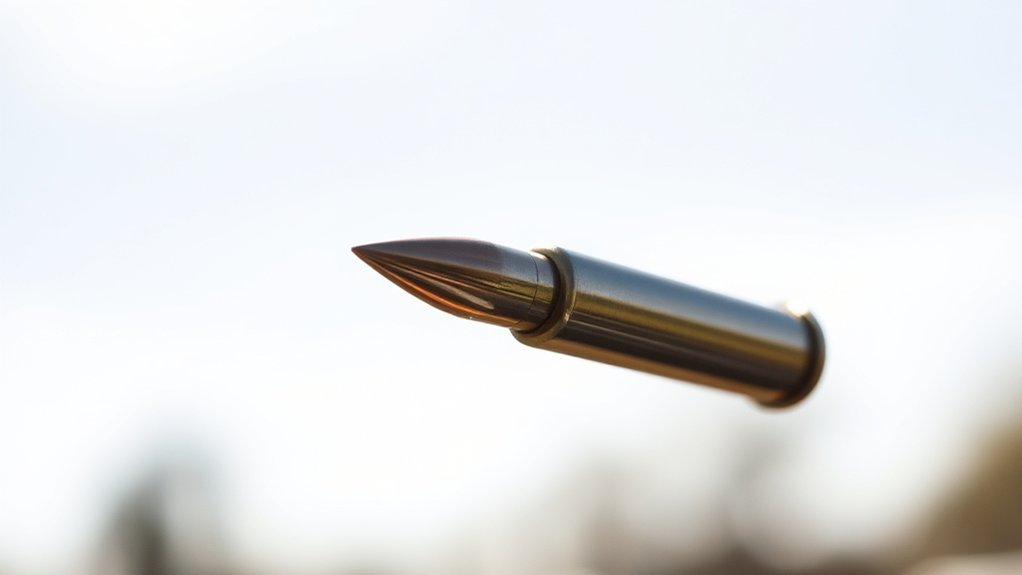
The typical muzzle velocity of 5.56 ammo generally falls between 2,700 and 3,300 feet per second, depending on factors like load and barrel length.
You’ll notice that a standard 55-grain FMJ round fired from a 20-inch barrel usually exits at around 3,100 fps.
Heavier bullets, such as 77-grain match loads, tend to have lower muzzle velocities, closer to 2,750 fps.
Barrel length plays a significant role; shorter barrels, like 14.5 inches, can reduce muzzle velocity by approximately 200-300 fps compared to longer barrels.
Manufacturer data and ballistic tests confirm that most 5.56 rounds stay within this velocity range.
So, when considering your firearm setup and bullet choice, remember that both load and barrel length influence how fast the bullets travel.
This range helps you understand the typical speed you can expect from 5.56 ammunition in various configurations.
What Factors Influence 5.56 Muzzle Velocity?
Numerous factors can influence the muzzle velocity of 5.56 ammunition, and understanding them can help you optimize your firearm’s performance.
Barrel length is a key factor—longer barrels, like 20 inches, typically produce higher muzzle velocities, around 3,100 fps.
Longer barrels, such as 20 inches, generally yield higher muzzle velocities around 3,100 fps.
In contrast, shorter barrels, such as 10.5 inches, may only reach about 2,500 fps.
Bullet weight also plays a role; lighter bullets, like 55 grains, tend to achieve higher velocities compared to heavier ones, such as 77 grains, at the same barrel length.
The type of propellant and load configuration impacts how quickly the powder burns, directly affecting muzzle velocity.
Environmental conditions like temperature, humidity, and altitude can alter powder combustion and projectile speed.
Additionally, firearm components like twist rate and barrel condition influence how efficiently the bullet accelerates, ultimately shaping the muzzle velocity you experience.
How Does Barrel Length Affect 5.56 Muzzle Velocity?
Barrel length plays a crucial role in determining the muzzle velocity of your 5.56 ammunition because longer barrels generally allow more complete combustion of the powder, which translates into higher projectile speeds.
As the barrel length increases, so does the muzzle velocity, improving ballistic performance. For example, a 20-inch barrel can produce muzzle velocities around 3,100 ft/sec, while a 10.5-inch barrel might only reach about 2,500 ft/sec.
Each additional inch of barrel length can add roughly 50 ft/sec to the muzzle velocity, depending on the load and firearm. Shorter barrels result in lower velocities, which can negatively impact trajectory, range, and terminal performance.
Conversely, the ideal barrel length for maximizing velocity is generally around 20 inches, balancing ballistic performance with handling and maneuverability.
How Do Different Loads Impact 5.56 Muzzle Speed?
Different loads of 5.56 ammunition can substantially impact your muzzle speed, with lighter bullets generally traveling faster than heavier ones.
For example, a 55-grain FMJ typically has a muzzle velocity around 3,200 fps, while a 77-grain BTHP drops to about 2,700 fps.
Bullet weight influences muzzle velocity because lighter bullets accelerate more easily, increasing initial speed.
The type of powder and load configuration also play critical roles in shaping muzzle velocity.
Additionally, barrel length affects these speeds, with longer barrels (around 20 inches) producing higher muzzle velocities overall.
| Load Type | Bullet Weight | Approximate Muzzle Velocity |
|---|---|---|
| Light Load | 55 grains | 3,200 fps |
| Heavy Load | 77 grains | 2,700 fps |
| Standard Load | 62 grains | 3,000 fps |
| Truncated | Varies | Slightly lower |
Different loads, combined with barrel length, markedly influence your firearm’s muzzle velocity.
Why Does Muzzle Velocity Matter for Accuracy and Range?
Muzzle velocity plays a key role in how accurately and effectively you can shoot at longer distances.
A higher speed helps control bullet drop, resist wind drift, and extend your reach.
Understanding this can make a big difference in hitting your target precisely when it counts.
Bullet Drop Control
Because higher muzzle velocities result in flatter trajectories, they play an essential role in controlling bullet drop and enhancing accuracy over long distances.
When your round travels faster, it maintains its speed longer, which minimizes the effects of gravity and environmental factors. This helps you keep consistent point-of-aim and reduces the need for complex adjustments.
- Faster muzzle velocity decreases bullet drop, making long-range shots more predictable.
- It shortens the bullet’s time of flight, allowing quicker target engagement.
- Maintaining high velocity improves terminal performance by increasing impact energy at extended ranges.
In short, a higher muzzle velocity ensures your projectile stays on a flatter trajectory, giving you better control over shot placement over varying distances.
Wind Drift Resistance
Higher muzzle velocities considerably enhance wind drift resistance, especially in challenging outdoor conditions.
When you fire high-velocity bullets, the increased muzzle velocity means the bullet spends less time in the air, reducing its exposure to crosswinds.
Rounds exceeding 2,700 fps tend to maintain a straighter trajectory, even in windy environments.
This results in less lateral displacement—about 4.3 inches of drift at 200 yards in a 10 mph crosswind for high-velocity 5.56 rounds.
Faster bullets are less affected by gusts, making your shot more accurate at longer ranges.
Virtually, higher muzzle velocity improves wind drift resistance by minimizing environmental influences, allowing you to better predict shot placement and achieve more consistent accuracy in outdoor shooting conditions.
Effective Engagement Distance
When it comes to hitting targets at longer ranges, muzzle velocity plays a significant role in determining how accurate your shots can be. Higher muzzle velocities, like 3,100 fps from a 20-inch barrel, produce flatter trajectories that boost accuracy at extended distances.
Faster ammo maintains higher impact energy, increasing your effective range and stopping power. Additionally, increased velocity reduces bullet drop and wind drift, making precise shots more achievable at longer engagement distances.
Variations in muzzle velocity—caused by barrel length or load—significantly impact your point of aim and overall shooting precision at distance. To maximize your effective engagement distance, consider these factors:
- Longer barrels boost muzzle velocity
- Higher velocity reduces bullet drop
- Consistent loads improve accuracy
How Do Environmental Conditions Change 5.56 Bullet Speed?
Environmental conditions like temperature, humidity, and altitude can directly impact the speed of your 5.56 rounds.
Warmer weather speeds up powder burn, while higher altitudes reduce drag, making bullets fly faster.
Wind and air density also play roles in how your shot travels, affecting both speed and accuracy.
Wind Influence on Velocity
Wind primarily affects the trajectory of a 5.56 bullet rather than its initial velocity, but it can still influence your shot’s accuracy and impact point.
While it doesn’t change the velocity directly, environmental conditions like wind push the bullet sideways, making precise aiming more challenging.
Crosswinds, in particular, can cause significant drift over distance, requiring adjustments.
Variations in environmental conditions—such as wind speed and direction—can cause fluctuations in muzzle velocity of up to 50-100 fps, subtly impacting ballistic performance.
To compensate, you need to account for wind influence during your calculations, especially at longer ranges.
Temperature Effects on Speed
Temperature plays a significant role in determining the speed of a 5.56 bullet, as changes in environmental conditions directly impact the burn rate of the propellant.
When temperatures rise, the propellant burn rate increases, resulting in higher muzzle velocity. Conversely, colder conditions slow down powder combustion, slightly reducing bullet speeds.
Environmental temperature variations can cause muzzle velocity differences of up to 50-100 fps. Elevated temperatures also raise barrel pressure and wear, impacting ballistic consistency over time.
To understand this better, consider the following:
| Condition | Effect on Muzzle Velocity |
|---|---|
| Hot Weather | Increased propellant burn rate, higher muzzle velocity |
| Cold Weather | Slower burn rate, reduced muzzle velocity |
| Moderate | Stable, consistent velocity |
These temperature effects are vital for accurate ballistic calculations.
Humidity and Air Density
In dry, low-altitude conditions, bullets tend to maintain higher speeds compared to humid, high-altitude environments. Elevated air density caused by humidity can decrease muzzle velocity by about 1-3%, making a noticeable difference over long ranges.
Changes in environmental conditions alter drag force, causing bullets to lose speed more quickly in humid air.
- Increased air density raises drag, slowing bullets.
- Humid conditions reduce muzzle velocity.
- Precise ballistic calculations must account for environmental variations.
How Does Muzzle Velocity Vary in Different Rifle Platforms?
Ever wondered why your 5.56 rounds perform differently across various rifle platforms?
It all comes down to muzzle velocity, which varies with rifle design and barrel length. Longer barrels, like those around 20 inches, typically produce higher muzzle velocities—over 3,100 ft/sec—because they allow more complete combustion of the powder.
In contrast, shorter barrels, such as 10.5 inches, often see velocities around 2,600 ft/sec, as less powder burns before the bullet exits. A standard 16-inch rifle usually hits between 2,800 and 2,900 ft/sec, depending on the load and bullet weight.
Different rifle platforms, including carbines and PDWs with barrels under 14 inches, can see velocities drop by 300–500 ft/sec compared to full-length rifles. Variations in rifle design, twist rates, and ammunition load all influence the muzzle velocity you experience in each platform.
What Are the Risks of Shooting With High Muzzle Velocity?
Shooting with high muzzle velocity isn’t without risks, as increased speeds put additional stress on your firearm.
Higher muzzle velocities can accelerate barrel wear and generate more heat, potentially shortening your gun’s lifespan.
Elevated velocities also lead to greater recoil and mechanical stress, which can impact your accuracy and safety.
Excessive velocity might cause bullets to become unstable or tumble, reducing terminal performance and penetration.
Additionally, firing high-velocity rounds from shorter barrels can produce unsafe pressures, risking firearm damage or failure.
You should also be aware that exceeding certain muzzle velocity limits could have legal implications, depending on regulations.
- Increased barrel wear and heat buildup
- Greater recoil affecting shot placement
- Potential for unsafe pressures or damage
Frequently Asked Questions
How Fast Does a 556 Round Move?
A 5.56 round generally moves between 2,700 and 3,300 feet per second, depending on factors like barrel length and bullet weight.
If you’re shooting from a standard 20-inch barrel, expect around 3,100 fps.
Shorter barrels, like 10.5 inches, produce velocities closer to 2,500 fps.
Lighter bullets go faster, but keep in mind, velocity drops as the round travels further, losing about 400-500 fps by 300-500 yards.
Is 5.56 Deadlier Than 9mm?
Yes, 5.56 ammo is generally deadlier than 9mm, mainly because it delivers more kinetic energy—often between 1,200 and 1,700 foot-pounds compared to about 350 for 9mm.
Its higher velocity, around 2,700 to 3,300 fps, allows it to cause more severe tissue damage and maintain effectiveness over longer distances.
How Much Does a 5.56 Drop Every 100 Yards?
You’ll see that a 5.56 round drops roughly 8-9 inches every 100 yards after being zeroed at 200 yards.
This pattern continues consistently, with about 8-11 inches of drop per 100 yards beyond 400 yards.
Keep in mind, factors like load, bullet weight, velocity, and zeroing distance can slightly influence the exact amount, but overall, the drop is fairly predictable.
Does 556 Travel Faster Than 223?
Yes, 5.56 travels faster than .223.
Think of it like a race where the 5.56 is fueled with a turbo boost—loaded to higher pressures and more powerful propellants.
This results in muzzle velocities typically between 2,700 and 3,300 fps, giving it a speed edge.
Conclusion
Understanding how fast 5.56 ammo travels helps you choose the right rifle and load for your needs.
For example, if you’re hunting or shooting at longer ranges, knowing that a typical muzzle velocity of around 3,000 fps can make a big difference.
By considering factors like barrel length and environmental conditions, you can optimize your shot accuracy and safety.
So, always stay informed—your shooting precision depends on it.
Remember, understanding the speed of 5.56 ammo is crucial for effective shooting.