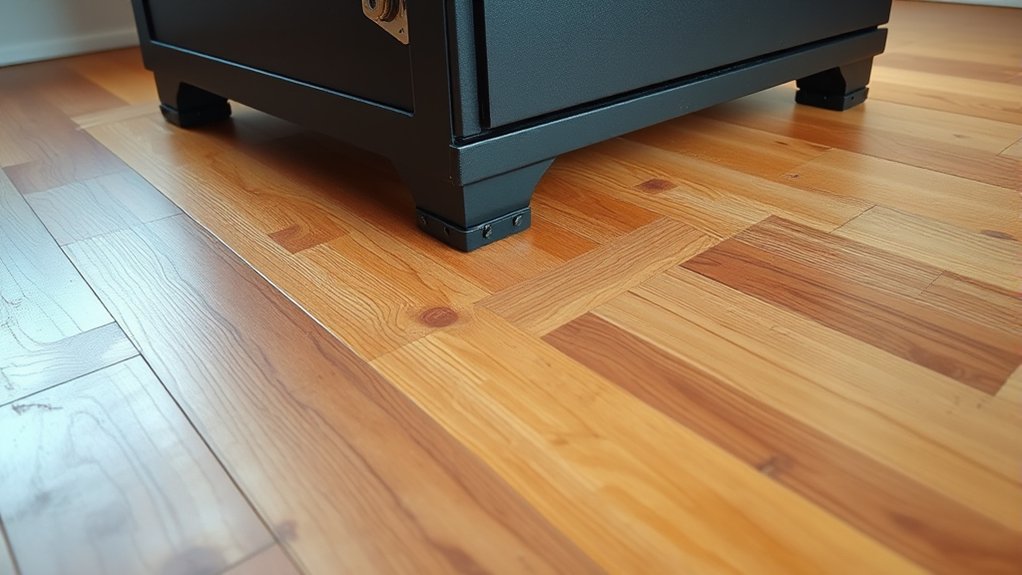
Can My Floor Support a Gun Safe?
When it comes to securing your firearms, choosing the right gun safe is just the beginning. Many people struggle with the question of whether their floors can support such heavy equipment. You’re not alone in this concern; the last thing you want is to invest in a safe only to find out it could compromise your home’s structure.
Understanding your floor’s capacity is crucial for ensuring both safety and peace of mind. Don’t worry—by taking the right steps, you can confidently assess your space for the perfect fit.
Let’s dive into what you need to check before making that important purchase.
To determine if your floor can support a gun safe, start by checking the condition of your flooring and note its support structure, like joist size, span, and placement.
Make sure the load isn’t over supported areas or unsupported spans, and look for signs of damage or weakness.
If your safe is heavy or you notice issues, reinforcement might be needed.
Keep in mind, proper placement and support are essential—continue to explore proven tips to guarantee your floor can handle the weight safely.
Key Takeaways
- The floor’s support capacity depends on joist size, span, spacing, and overall structural condition.
- Placing the safe over load-bearing walls or perpendicular to joists provides better support.
- Signs of support issues include sagging, cracks, creaking, or damaged subflooring.
- Reinforcement methods like additional supports, bridging, or steel plates enhance load capacity.
- Consult a structural engineer if the safe is very heavy or if there are concerns about floor integrity.
How Can You Check If Your Floor Supports a Heavy Safe?
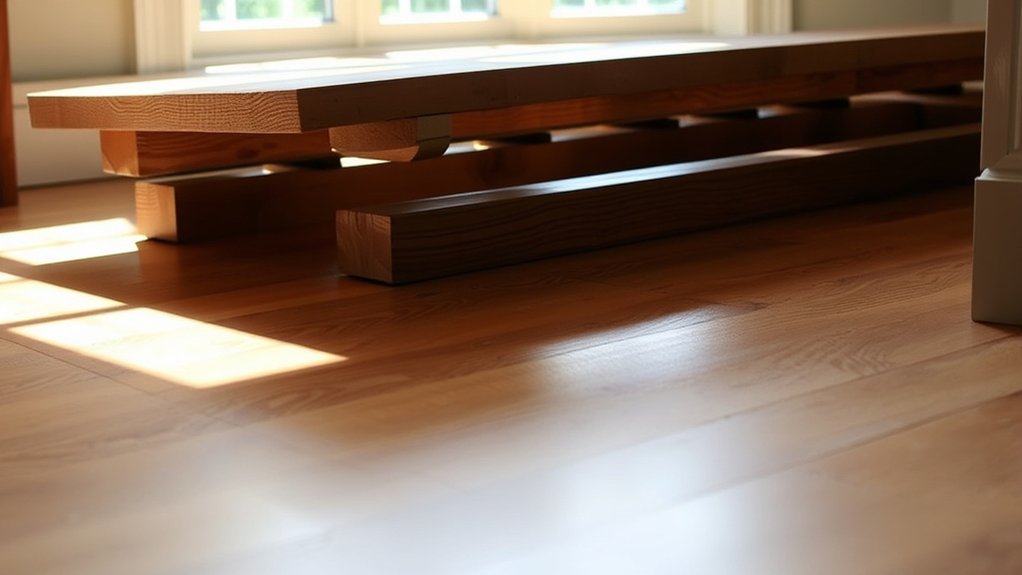
If you’re planning to place a heavy safe on your floor, it’s important to determine whether the structure can support the weight. Start by measuring the span of your floor joists and noting if they are 16, 12, or 24 inches on-center, since shorter spans usually support more load.
Next, locate bearing walls or support beams—positioning the safe near these areas helps distribute the weight more evenly. A structural assessment, ideally with the help of a professional engineer or by reviewing your home’s structural plans, can provide insight into your floor’s load capacity.
Placing the safe near support beams or bearing walls ensures better weight distribution and floor stability.
Look for signs of existing issues, like sagging or creaking, which may indicate insufficient support. Using a floor load calculator or gathering info about your joist size and spacing can also help estimate how much weight your floor can bear per square foot.
These steps are vital to guarantee your floor can safely support a heavy safe.
What Factors Affect Your Floor’s Support Strength?
The strength of your floor’s support heavily depends on several key factors. First, the span length of your floor joists matters—a longer span, like 15 feet, weakens support compared to shorter spans such as 8 feet.
The type and size of your supporting beams and the spacing of your floor joists also play an essential role; thicker joists like 2x12s spaced 12 inches on-center provide more support than narrower, more widely spaced ones.
Structural features such as notches or holes for pipes can create stress points, reducing overall strength. Additionally, the presence of supporting beams or bearing walls beneath the floor greatly boosts its load-bearing capacity, making it better suited for heavy safes.
Wood imperfections—knots, insect damage, or rot—also weaken the framing over time, decreasing support strength. All these factors combined determine whether your floor can safely hold a heavy gun safe.
When Should You Reinforce or Modify Your Floor?
You should consider reinforcing or modifying your floor if you notice cracks, sagging, or other signs of structural weakness.
If you’re planning to place a heavy safe over unsupported spans or damaged joists, upgrading your flooring is essential.
When in doubt, consulting a structural engineer can help determine if your floor can support the added weight safely.
Signs of Structural Weakness
Recognizing when your floor might need reinforcement is essential before installing a heavy gun safe. Signs of structural weakness include visible floor sagging, bouncing, or creaking, which suggest the load-bearing capacity may be compromised.
Cracks or gaps in the subfloor or between floorboards can also indicate weakened support, reducing safety. Moisture damage, rot, or insect infestation weaken wood framing, making it less capable of supporting heavy loads.
Additionally, long joist spans exceeding 12-15 feet without support can cause deflection, signaling the need for added beams. Non-supportive partition walls or unbraced sections under the floor further decrease load capacity.
| Warning Signs | Potential Issue |
|---|---|
| Floor sagging or bouncing | Structural weakness, load issues |
| Cracks or gaps in flooring | Reduced load-bearing capacity |
| Moisture or rot damage | Weakened framing, unsafe support |
| Long joist spans | Deflection risk, need for reinforcement |
| Unbraced/support-less sections | Insufficient load capacity |
Planned Heavy Load Placement
If you’re planning to place a heavy safe that weighs over 1,000 pounds, it’s crucial to evaluate floor reinforcement or modifications to prevent structural issues.
First, assess your floor’s load capacity by inspecting the span of your joists; longer spans, like 15 feet, decrease load capacity and require reinforcement.
Adding bridging, blocking, or steel straps between joists can greatly increase their strength.
Installing a steel plate or additional support beneath the safe helps distribute the concentrated weight, reducing stress on individual joists.
If your floor has existing weaknesses or non-load-bearing partitions, consult a structural engineer before proceeding.
Reinforcing your floor ensures it can safely support your heavy safe and avoids costly damage or safety hazards down the line.
Where Is the Best Place to Put Your Gun Safe?
The best place to put your gun safe is near a load-bearing wall, which provides better support and stability. This guarantees your floor support can handle the weight without risk of sagging or damage.
Positioning the safe perpendicular to floor joists helps distribute the weight evenly across multiple joists, reducing stress on any single point. An accessible location is also important, so you can quickly retrieve your firearms in emergencies.
Placing your safe perpendicular to joists evenly distributes weight and enhances accessibility for quick retrieval.
However, avoid placing the safe in unconditioned spaces like garages or basements, where temperature and humidity fluctuations can harm your valuables. Reinforcing the floor with additional support or steel plates under the safe can further improve load capacity and prevent sagging over time.
Remember to steer clear of weak or unsupported sections of the floor, especially over long spans or non-load-bearing partitions. Choosing the right spot ensures your safe remains secure and your floor remains structurally sound.
Which Floors Are Best for Installing and Anchoring a Heavy Safe?
When installing and anchoring a heavy safe, concrete floors stand out as the best choice because of their superior stability and load-bearing support.
Basements and garages typically have concrete floors that can handle the weight and anchoring demands of a safe. Natural stone floors can also support heavy safes if proper anchoring is used.
However, tile floors with high PEI ratings (III, IV, V) are suitable, but ceramic tiles are risky due to cracking.
Supportive subflooring, like reinforced plywood or concrete slabs, further enhances stability on various floors. Floors with weak sections, such as certain wooden or vinyl surfaces without reinforcement, may need additional support before installation.
Here’s a quick comparison:
| Floor Type | Support Level | Anchoring Suitability | Notes |
|---|---|---|---|
| Concrete floors | Excellent | Ideal for heavy safes | Best for stability |
| Natural stone | Good | Proper anchoring needed | Similar to concrete |
| High PEI tile | Moderate | Possible with reinforcement | Avoid ceramic due to cracking |
| Wooden/Vinyl floors | Limited | Additional support needed | Reinforce before anchoring |
How Do You Properly Anchor Your Safe for Maximum Security?
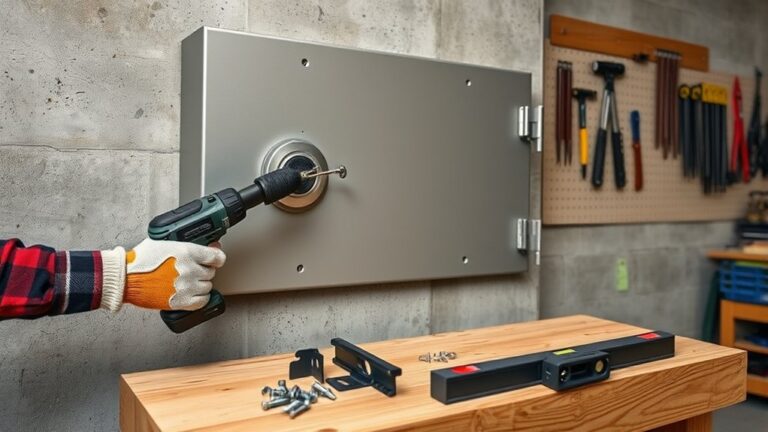
To guarantee your safe provides maximum security, it is essential to properly anchor it using the right hardware and techniques.
First, use pre-drilled holes and sturdy anchoring bolts designed for your floor type—concrete or wood—to securely fasten the safe.
If floor anchoring isn’t an option, anchor the safe to wall studs with appropriate hardware, ensuring a firm connection.
For added reinforcement, consider installing a steel plate or reinforcement under the floor to distribute the weight evenly and prevent damage.
Always anchor the safe perpendicular to joists or reinforcement beams to maximize load distribution and stability.
What Common Mistakes Should You Avoid When Placing a Heavy Safe?
One common mistake is placing your safe on weak or unsupported floor areas, which can cause damage or collapse.
You should also avoid setting it over notches or cutouts in the joists that weaken their load capacity.
Additionally, don’t forget to take into account the overall weight in the room and reinforce the structure if needed to prevent damage.
Avoid Weak Floor Areas
Placing a heavy safe requires careful attention to the condition of your floor, as even small weaknesses can lead to serious problems.
A weak floor can sag or collapse, risking damage to your safe and your home. To avoid this, steer clear of these common mistakes:
- Placing the safe over unsupported or span-length areas between joists, which weakens support and threatens structural integrity.
- Positioning it on floors with visible damage, insect infestations, or dry rot that compromise load-bearing capacity.
- Drilling notches or cuts into floor joists near the safe, creating stress points that weaken support.
Don’t Ignore Floor Support
You shouldn’t overlook the importance of proper floor support when installing a heavy safe, as neglecting this can lead to serious structural issues.
Guaranteeing adequate reinforcement is key to distributing the load capacity evenly across multiple joists, preventing sagging or cracking over time.
Avoid placing the safe directly over unreinforced or unsupported sections, especially long-span joists, without adding extra support.
Using reinforcement methods like bridging, blocking, or steel plates helps spread the load and prevents concentrated stress that can weaken your floor.
Relying solely on the existing safety factor of your floor without proper assessment can risk exceeding its load capacity.
Proper reinforcement ensures your floor can safely support your safe’s weight for the long term.
Prevent Floor Damage
Have you considered the common mistakes that can lead to floor damage when installing a heavy safe?
Improper placement can jeopardize your floor support and weaken the structural integrity of your home. To prevent this, avoid these pitfalls:
- Placing a safe directly on carpeted floors without a rigid, level base—this causes uneven weight distribution and shifting.
- Drilling into floor joists or support beams—this weakens the structure and risks long-term damage.
- Positioning safes on unsupported or weak sections, especially over unreinforced subflooring or between joists without reinforcement.
Ignoring moisture-prone areas or existing damage can also lead to rust or stress points.
Proper reinforcement and thoughtful placement protect your floor from costly damage.
When Is It Time to Consult a Professional?
Knowing when to call in a professional is crucial to guarantee your floor can safely support a heavy safe.
Consult a professional to ensure your floor can safely support a heavy safe.
If your safe exceeds 1,000 pounds, it’s wise to seek a structural assessment from a qualified expert. When placing a safe over unsupported or weak flooring sections, professional consultation ensures the structural support is adequate.
If you notice sagging, creaking, or visible damage in the area where you plan to install the safe, it’s essential to get an evaluation before proceeding.
For older homes or those with compromised framing, a professional can identify whether additional reinforcement is necessary.
Planning to move or install a very heavy safe also warrants expert advice to prevent structural damage and ensure proper load distribution.
Ultimately, consulting a professional guarantees your floor’s integrity and safety, giving you peace of mind that your investment is securely supported.
Frequently Asked Questions
Is My Floor Strong Enough for a Gun Safe?
Your floor might be strong enough for a gun safe if it’s a standard residential raised wood floor supporting around 40 pounds per square foot.
To be sure, consider placing it near a bearing wall or reinforcing the joists.
Consulting a professional is also a good idea, especially if your safe is heavy or the span is long.
These steps help confirm your floor can handle the weight safely without risking damage or safety issues.
Can a Floor Hold 1000 Pounds?
Yes, your floor can hold 1,000 pounds if it’s properly constructed, but it depends on several factors.
Wooden floors with good joist spacing and support beams often support around 40 PSF, roughly 800 pounds per 20×20 area.
To safely place that much weight, position the load over load-bearing walls and multiple joists.
To be sure, it’s best to consult a structural engineer or contractor for an accurate assessment.
How Much Weight Can I Put on My Floor?
Your floor can typically support at least 40 pounds per square foot if it’s a standard residential wooden floor.
The actual capacity depends on your joists’ size, span, and support structure. Shorter spans and reinforced beams mean more weight.
For heavy safes over 1,000 pounds, you might need reinforcement.
To be safe, it’s best to consult a structural engineer or professional contractor to determine your specific floor’s capacity before placing a heavy item.
How Much Weight Can My Floor Joists Hold?
Your floor joists can typically carry around 40 pounds per square foot, depending on their span, size, and condition.
Longer spans weaken the weight capacity, but reinforcing with bridging or steel straps can bolster support.
Placing a safe near a bearing wall or across multiple joists helps distribute weight evenly.
Always consider your specific joist type and layout, and consult a professional if unsure—safety starts with solid support.
Conclusion
Ultimately, your floor’s strength is the foundation of your safety. Just as a sturdy ship depends on its keel, your safe relies on a solid support.
Don’t wait until cracks appear or weight shifts—assess, reinforce, and anchor wisely.
Remember, a well-placed safe isn’t just about security; it’s about peace of mind, ensuring your valuables stand firm through life’s storms.
Protect your treasures; your floor’s integrity is the first line of defense.
Can my floor support a gun safe? It’s crucial to ensure that your floor can handle the weight and provide the security you need.