What Ammo Does the M1 Garand Use: A Complete Guide for Safe, Accurate Shooting
What ammo does the M1 Garand use? The M1 Garand is chambered for .30-06 Springfield ammunition, specifically designed to handle pressures near 50,000 PSI. Always use ammo explicitly labeled for the M1 Garand to ensure safety, reliability, and proper function. Using the correct ammunition prevents malfunctions and maintains the rifle’s performance, especially since the M1 Garand’s unique en bloc clip requires specific rounds for smooth feeding.
Key Takeaways
- Use .30-06 Springfield ammo labeled for M1 Garand to prevent damage and ensure reliable cycling.
- The M1 Garand operates safely at chamber pressures around 50,000 PSI, avoid high-pressure rounds.
- En bloc clips hold eight rounds and must be fully loaded with compatible .30-06 cartridges to function properly.
- Using ammo with bullet weights between 150 and 175 grains balances accuracy and rifle longevity.
- Handloading allows customization of pressure and bullet weight but requires strict attention to safe loads.
- Surplus M2 Ball ammo is a reliable and historically accurate choice for M1 Garand shooting.
What Ammunition Does the M1 Garand Officially Use?

The M1 Garand officially uses the .30-06 Springfield cartridge, specifically the M2 Ball round, as its standard ammunition. This cartridge features a 150-grain full metal jacket bullet designed for reliable cycling and safe operation within the M1 Garand’s pressure tolerance. The rifle is built to handle chamber pressures around 42,000 to 50,000 psi, matching the original military specifications of the M2 Ball cartridge.
The M2 Ball ammo was developed explicitly for the M1 Garand to ensure consistent performance under combat conditions. Its pressure profile and bullet weight offer optimal function without overstressing critical rifle components like the operating rod and receiver. This balance between pressure and bullet design also aligns with the sights calibrated for the standard ballistics of this round, helping maintain accuracy and reliable feeding during semi-automatic cycling.
It is essential to use ammunition that does not exceed the M1 Garand’s designed pressure limits, typically about 50,000 psi. Many modern factory loads for .30-06 can reach pressures above 60,000 psi, which poses a serious risk of damage. Overpressure rounds can cause catastrophic failures, including bent or broken operating rods and receiver damage, resulting in costly repairs and unsafe firearm operation. Carefully checking the ammo specifications or consulting manufacturers’ data ensures you safely adhere to pressure limits.
Handloaded ammunition offers a way to tailor pressure and bullet weight for your specific M1 Garand. When handloading, keeping chamber pressure below 50,000 psi and bullet weight between 150 and 175 grains is key to safe, smooth function. Going beyond these limits may damage essential parts or cause malfunctions. Proper handloading tools and reliable load data should always be used, and novice reloaders should consult experienced sources or professionals.
Ammo outside military specifications, particularly overpressure or heavy bullet rounds, can compromise reliability and safety. The M1 Garand’s design depends on carefully balanced ballistics, making it important to stick with original military spec or equivalent commercial ammunition. Choosing the correct ammo not only protects your rifle but assures consistent cycling and accuracy designed into this historic semi-automatic rifle.
How the M1 Garand’s En Bloc Clip Works with Ammo
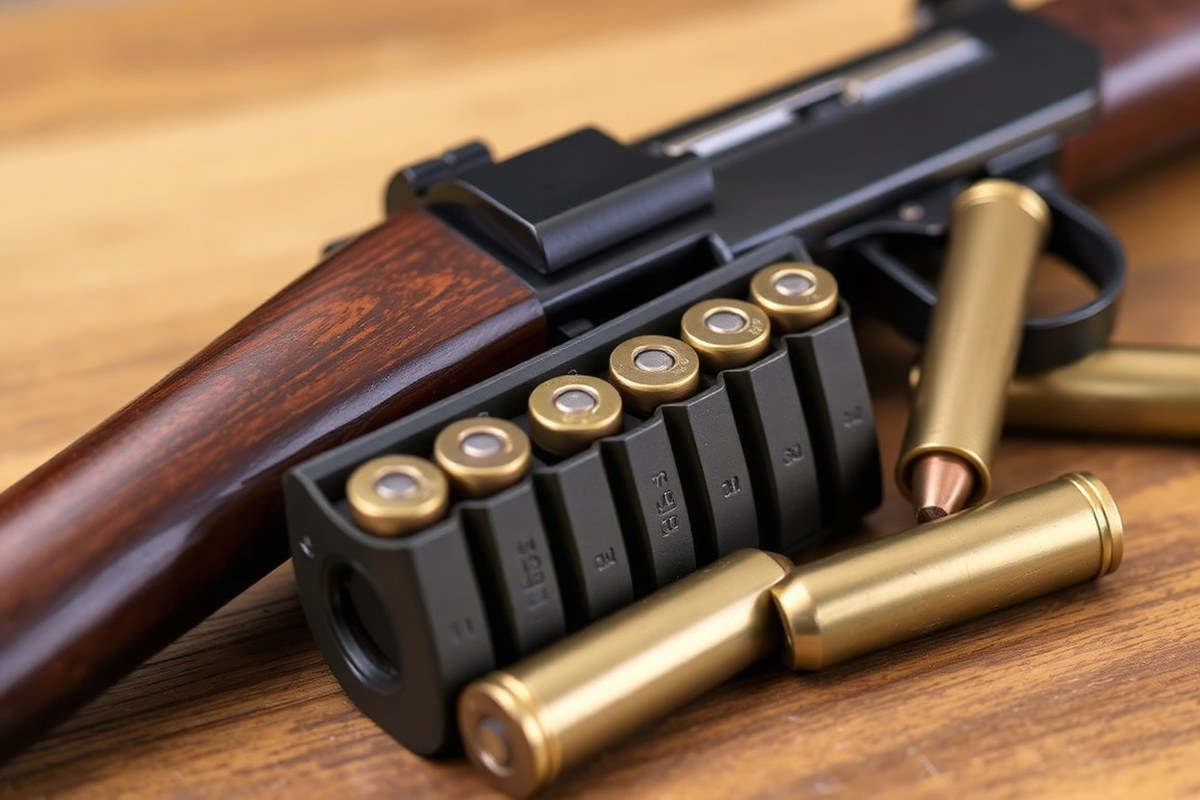
The M1 Garand loads .30-06 Springfield cartridges through an eight-round en bloc clip that inserts directly into its fixed magazine. This clip locks firmly within the rifle’s mechanism, allowing rapid reloading by inserting the entire clip in a single motion. Feeding bullets without using the proper en bloc clip will not function correctly, so always ensure you use the designated clip for reliable performance.
En Bloc Clip Design Features
The en bloc clip for the M1 Garand holds eight .30-06 rounds in a single, rectangular metal frame. It inserts from above into the rifle’s fixed internal magazine. This clip is ejected automatically after the last round is fired, producing the distinctive “ping” sound. The clip design helps maintain proper alignment and ensures smooth feeding tied to the rifle’s gas-operated cycling system.
The clip restricts loading to eight rounds at a time and does not allow single-round loading without a clip. While some modern conversions exist, the original en bloc clip remains essential for standard M1 Garand operation. The clip also adds weight and complexity but supports the rifle’s need for quick, continuous fire with minimal interruption.
Step-by-Step Loading Process
Proper loading with the en bloc clip maximizes reliability and safety. To load your M1 Garand reliably, follow these exact steps:
- Hold the rifle with the ejection port facing up and open the bolt by pulling it fully rearward.
- Insert your fully loaded eight-round en bloc clip into the magazine well from the top until it snaps firmly into place.
- Release the bolt slowly to allow it to strip the top cartridge and chamber it without forcing the action.
- Check that the clip is properly seated and the bolt closes completely.
- After firing, confirm the empty clip ejects automatically once the last bullet fires to ensure smooth chambering of new rounds.
- Keep your fingers clear of the ejection port during firing to avoid injury from clip ejection.
Always load and unload on safe, and never attempt to force rounds into the chamber without the en bloc clip fully seated.
Troubleshooting Common Loading Issues
Loading problems often stem from incorrect clip seating or improper bolt manipulation. When the clip fails to lock into place, inspect the magazine well and clip for dirt or damage that might prevent proper engagement. Avoid forcing the clip as this can cause jams or damage to the feed lips.
Inconsistent feeding or failure to chamber rounds can result from only partially releasing the bolt. Make sure to let it snap forward fully. Using ammo designed for bolt-action rifles, rather than ammo rated for semi-auto pressures and Garand use, can also cause feeding and cycling malfunctions.
Non-en bloc feeding attempts are not recommended and typically require aftermarket modifications that alter rifle function and reliability. Stick to original or M1 Garand-specific clips to maintain safe operation.
Why Some .30-06 Ammunition Is Unsuitable for the M1 Garand
The M1 Garand requires .30-06 ammunition that meets specific pressure and gas system standards. Some .30-06 rounds exceed these limits or behave differently, which can harm your rifle’s function and durability. Using the wrong ammo risks increased wear, damage to internal parts, and reliability issues.
Common Ammo Types to Avoid
Not all .30-06 cartridges are safe for the M1 Garand. High-pressure commercial hunting loads often generate gas pressures beyond what the rifle’s gas system can handle. Tracer rounds and blank rounds not specifically made for the Garand can cause damage or malfunctions due to inconsistent pressure or burn characteristics. Always select ammunition designed for the M1 Garand, like Hornady’s 168-grain ELDM or Hornady Vintage Match .30-06 loads. These are engineered to maintain safe, consistent pressure suitable for your rifle’s gas system. Choosing rounds from manufacturers reputable among Garand shooters, such as Prvi Partizan (PPU), reduces the chance of damage and ensures reliable cycling.
How Excess Pressure Damages the Rifle
The M1 Garand’s gas-operated system relies on a carefully balanced pressure to cycle the action correctly. Ammunition generating pressures too high for the gas port can cause excessive force on the operating rod, leading to accelerated wear or damage to the op rod, gas cylinder, and other moving parts. Overpressure can also stress the receiver and bolt, risking cracks or deformation over time. When pressure exceeds design limits, the timing of the bolt’s unlocking and extraction can get off sync, causing failure to eject or feed. This kind of damage may not be immediately visible but reduces the rifle’s lifespan and increases the likelihood of costly repairs.
Recognizing Ammo-Induced Malfunctions
Malfunctions from unsuitable ammunition often show as failures to eject spent cases, stove-piped cartridges, or shortened cycling where the bolt does not fully travel rearward. If you notice repeated jams or difficulty loading rounds, it might reflect improper gas pressures from your ammo. Physical signs of damage include dents or deformations on the operating rod and receiver, cracked or worn gas cylinder components, or abnormal marks on spent casings caused by irregular pressure. Regular inspection after shooting sessions helps detect these issues early. Stop using any ammo that leads to more than occasional, minor malfunctions to protect your Garand’s function and preserve its historical value.
Handloading Ammo for the M1 Garand: Safety and Performance Tips
You can use handloaded ammo in your M1 Garand, but it requires careful attention to bullet weight, powder choice, and pressure to ensure safety and reliable function. Staying within recommended parameters keeps the rifle operating smoothly and prevents damage from excessive pressures. Precise control over components and measurements makes handloading a practical option for custom accuracy and performance tuning.
Recommended Bullet Weights and Types
Bullet weights between 150 and 175 grains are ideal for the M1 Garand. This range mirrors the original M2 ball loads and balances chamber pressure and recoil well. Bullets lighter than 150 grains may reduce accuracy and cycling reliability, while weights heavier than 175 grains often generate unsafe pressure levels above 50,000 psi. Aim for full metal jacket or match-grade bullets designed for consistent expansion and flight stability.
For example, a 168-grain Hornady ELD Match bullet is a popular choice that offers excellent accuracy while maintaining safe pressure margins. Stay within overall cartridge length specifications, like 3.250 to 3.285 inches, to ensure reliable feeding from the en bloc clip. Avoid exotic or highly compressed bullet profiles that can raise peak pressures unexpectedly.
Choosing Powders for Correct Pressure
Select powders that produce a burn rate and pressure curve compatible with the M1 Garand’s operating limits, around 50,000 psi. IMR-4895 is a traditional choice, designed with the Garand’s gas system in mind. It burns efficiently in this pressure range without risking excessive pressures that modern powders can cause.
Some newer powders, like Accurate 2495 or Accurate 2520, allow for fine-tuning velocity and grouping without raising pressures dangerously high. Note that many modern powders burn progressively, maintaining high pressure far down the barrel, which might overstress the gas port or receiver. Always consult reliable load data specifically for the Garand and avoid loads approaching or exceeding 60,000 psi, the SAAMI max for .30-06 but too high for this rifle.
Safety Checklist for Handloading Garand Ammo
Follow this checklist to help ensure your handloaded ammo stays safe and functional in the M1 Garand:
- Use bullet weights strictly between 150 and 175 grains.
- Stick to powders like IMR-4895 or Accurate 2495 with Garand-specific load data.
- Keep chamber pressure under 50,000 psi, ideally below 44,500 CUP for extra margin.
- Maintain cartridge overall length near 3.250 inches to ensure proper feeding.
- Measure and weigh all powder charges precisely; avoid shortcuts.
- Test each load at low velocity first, watching for signs of excessive recoil or gas system stress.
- Regularly inspect brass and primers for signs of overpressure such as flattened primers or case head expansion.
Handloading requires patience and discipline. Start with published Garand load recipes from reputable sources and increase powder charge in small increments only. Test shooting multiple rounds for consistent group sizes and reliable ejection is important before committing to bulk production. Precision in crafting your own ammo can yield superior accuracy and enjoyable shooting, as long as safety limits remain firm.
Recommended Commercial and Surplus Ammunition Brands
For your M1 Garand, selecting the right commercial or surplus ammo depends heavily on balancing reliability, cost, and availability. Federal American Eagle offers dependable 150-grain FMJ rounds specifically labeled for M1 Garand use, making them a top choice for consistent performance. Winchester’s 150-grain M2 Ball and Freedom Munitions’ 147-grain FMJ provide cost-effective, factory-ball options designed to meet appropriate pressure levels necessary for safe cycling in your M1. Surplus ammo, coming primarily from countries like South Korea, Ethiopia, and Greece, offers a budget-friendly alternative but requires extra caution as its condition and performance can vary widely due to factors such as age and storage.
Prices for commercial ammo typically range from $0.75 to $1.20 per round, while surplus ammo can be found for as low as $0.30 to $0.60. The biggest tradeoff with surplus is the uncertainty regarding pressure and consistency, which can affect accuracy and function. Factory ammo brands maintain strict quality controls, which is important given the M1 Garand’s sensitivity to ammo specifications. Testing in CMP-refurbished M1 Garands shows that commercial match-grade ammunition tends to produce tighter 10-shot groups at 100 yards, but well-chosen surplus can be reliable if inspected and tested carefully.
| Brand / Source | Bullet Weight (grains) | Price per Round (approx.) | Availability | Pressure & Suitability | Typical Accuracy (10 shots, 100 yd) |
|---|---|---|---|---|---|
| Federal American Eagle | 150 FMJ | $1.10 | Good, widely available | Meets M1 specifications | 1.5, 2.0 MOA |
| Winchester M2 Ball | 150 FMJ | $0.90 | Moderate | Meets M1 specifications | 1.5, 2.5 MOA |
| Freedom Munitions | 147 FMJ | $0.80 | Moderate | Meets M1 specifications | 1.5, 2.0 MOA |
| South Korean Surplus | 150 FMJ | $0.40 | Variable | Varies; inspect before use | 2.5, 4.0 MOA |
| Ethiopian Surplus | 150 FMJ | $0.35 | Limited | Varies; carefully tested advised | 3.0, 5.0 MOA |
Choosing commercial ammo tends to provide higher reliability and better accuracy, especially useful for competition or regular range use. Surplus rounds can save money but risk inconsistent feeding or pressure issues, so test small batches first to verify function before bulk buying. Keeping your M1 Garand in safe working condition means sticking to ammo within the proper pressure range and avoiding corrosive primers often found in older surplus ammunition.
Always inspect surplus ammo closely for corrosion or damage and run function tests before relying on it for regular shooting in your M1 Garand.
How Bullet Weight and Velocity Affect the M1 Garand’s Accuracy and Function
Bullet weight strongly influences both the accuracy and recoil of the M1 Garand. Bullets ranging from 150 to 175 grains typically provide the best balance for this rifle. Lighter bullets near 150 grains often cause less recoil and faster muzzle velocity, which can improve follow-up shot speed and shooting comfort. Heavier bullets closer to 175 grains usually improve stability and penetration at longer ranges but increase recoil, which might affect shooter endurance during extended sessions.
Velocity also plays a critical role in how the M1 Garand cycles. The rifle functions reliably within a muzzle velocity range roughly between 2,600 and 2,900 feet per second (fps). Loads below this range may not generate enough gas pressure to operate the semi-automatic action properly, causing failures to cycle. On the other hand, excessively high velocities can increase recoil and wear from faster cycling. Measured muzzle velocities around 2,640 to 2,800 fps often represent the sweet spot for both accuracy and reliable cycling, especially with ammunition loaded to military specifications like the Cal. .30 M1 or Cal. .30 M2 rounds.
Recoil in the M1 Garand is generally considered moderate for a .30-06 cartridge. The rifle’s weight and gas-operated action help absorb some of the kick, making the felt recoil more manageable compared to bolt-action rifles firing similar cartridges. This balance allows for quicker target reacquisition and less shooter fatigue. Excessive recoil from heavier bullets or hotter loads can lead to discomfort and negatively impact shot placement, especially during rapid fire or competitive shooting scenarios.
Testing various loads within the recommended bullet weight and velocity parameters is the best way to identify which ammo delivers optimal accuracy and consistent cycling in your specific rifle. For instance, loads using 150 to 170 grains of bullet weight at velocities between 2,600 and 2,750 fps generally result in good groupings at 300 yards without causing excessive recoil or cycling issues. Adjusting bullet weight and velocity slightly outside these ranges may cause you to experience increased muzzle blast or decreased accuracy, so sticking close to this performance envelope is important.
To choose ammo that suits your M1 Garand, start by selecting commercially available loads within the 150-175 grain bullet weight range, then note their listed muzzle velocities to ensure they fall within the effective cycling range. Pay attention to your rifle’s recoil response during shooting sessions. If you experience excessive muzzle rise or discomfort, consider moving toward lighter bullets or slightly lower velocity loads. In contrast, if you notice cycling failures or unstable groups, heavier bullets or moderately higher velocities may improve function and precision.
How to Identify Safe and Suitable Ammo for Your M1 Garand
To keep your M1 Garand functioning safely and reliably, confirming that your ammunition is suitable is key. Look for ammo specifically marked as “M1 Garand safe” on the packaging or description. This label indicates that the load conforms to pressure and cartridge specifications tested for the rifle. Some manufacturers tailor their rounds to match the M1 Garand’s requirements, such as a 168-grain A-Max load by Freedom Munitions designed for consistent ballistics and reliable cycling.
Checking cartridge markings and labels ensures the ammo matches the original M2 Ball specifications. These specifications maintain standard pressures and bullet weights needed so the Garand’s gas system and en bloc clip function correctly. When reloading your own ammo, compare your measured pressures and bullet weights with M2 Ball standards to ensure each round remains safe and consistent. Using higher-pressure modern loads without modification can damage your rifle or cause malfunctions. Planning to shoot hotter rounds calls for installing a vented gas plug made specifically for the M1 Garand to protect your firearm.
When buying ammo, avoid any loads not explicitly tested or recommended for the M1 Garand. Be cautious with surplus or military ammunition that lacks clear labeling. Some surplus .30-06 rounds have bullet weights or cases not suitable for the gas system, which could increase wear or cause jams. Also, avoid steel-cased or corrosive ammo unless you are ready to clean the rifle thoroughly after each session. Using blanks requires strict adherence to firearm safety protocols because the absence of a bullet changes cycling and gas pressure.
- Verify box or product description states “M1 Garand safe” or equivalent wording.
- Confirm bullet weight is close to 150, 168 grains, matching M2 Ball standards.
- Check the manufacturer’s information for load pressure and design intent on M1 Garand use.
- Avoid surplus ammo without clear proof of M1 Garand compatibility.
- Be cautious with steel cases and corrosive primers if not prepared for extra cleaning.
- Installing a vented gas plug designed specifically for the M1 Garand is recommended when using hotter or custom loads.
- Follow blank ammunition safety rules strictly if using blanks.
Good results mean smooth feeding and ejection, no excessive recoil or gas blowback, and consistent accuracy without part wear or damage. Common signs something is wrong include frequent jams, gas system fouling, or cracked en bloc clips. Always cross-reference product info with trusted sources or M1 Garand forums where users share tested ammo recommendations. Taking time to verify these details will protect your rifle and improve your shooting experience.
Common Ammunition-Related Malfunctions and How to Fix Them
Malfunctions caused by ammo in an M1 Garand often include stove-pipes, feeding failures, and hangfires. Stove-pipes happen when a spent casing fails to eject properly, sticking out of the ejection port. This usually results from underpowered ammunition or debris in the chamber and gas system. Feeding failures occur when rounds don’t load correctly from the en bloc clip into the chamber, often caused by ammo that is out of specification or dirty clips. Hangfires, the delayed firing of a cartridge after the trigger pull, might arise from old or contaminated primers.
Recognizing these issues quickly helps you maintain control and resume shooting safely. Stove-pipes appear as a casing caught in the ejection port, blocking the bolt. Feeding failures manifest as the bolt locking back with an empty chamber, and hangfires show as a noticeable delay between trigger pull and discharge, warranting immediate bolt lock-back to check safety. Consistent function depends heavily on ammo quality; low-quality or military surplus ammo that is old or improperly stored can increase malfunctions.
- For stove-pipes, do a tap-rack-bang: firmly tap the rifle’s grip to ensure the bolt is closed, rack the charging handle back to eject the stuck casing, then release and fire.
- Feeding failures require clearing the clip and chamber: lock the bolt back, remove the en bloc clip, inspect and reload with clean, correctly sized ammo.
- Hangfires demand a safety pause: keep the rifle pointed downrange, wait at least 30 seconds before unloading to avoid accidental discharge.
- Use only .30-06 ammo designed or proven safe for the M1 Garand to reduce malfunctions.
- Inspect and clean the gas system regularly, as gas ports clogged with residue can affect cycling and case ejection.
- Replace worn or damaged en bloc clips, which can cause feeding problems regardless of ammo quality.
- Avoid modern hunting ammunition, especially 180-grain rounds, that often cause jams or damage.
Always maintain muzzle discipline and keep the rifle pointed downrange during any malfunction clearance to prevent injury from unexpected discharge or ejected casings.
Cleaning supplies and replacement clips cost around $10 to $20 and take minutes to install or use, making proper maintenance a low-cost investment in reliable function. Using reputable manufacturers or remanufactured ammo like Freedom Munitions or high-quality Serbian surplus typically yields fewer feeding and ejection issues. In contrast, older surplus ammo or incompatible loads increase the risk of jams and dangerous hangfires. Paying attention to the ammo source and condition can save time and frustration during shooting sessions.
Step-by-Step Action Plan for Using Ammo Safely in Your M1 Garand
Follow these steps to safely select and use ammunition in your M1 Garand, ensuring reliable function and good shooting results.
- Before You Shoot: Check your ammo to confirm it is standard .30-06 Springfield with standard pressure and bullet weight recommended for the M1 Garand. Avoid any rounds labeled as “high pressure” or with non-traditional bullet shapes. Knowing the ammo is safe prevents malfunctions.
- First Range Visit: Load your M1 Garand with the appropriate en bloc clip fully loaded with the verified ammo and fire a few rounds. Observe whether the rifle cycles properly without jams or misfeeds as an indicator of ammo compatibility.
- After Initial Firing: Inspect your rifle’s chamber and en bloc clip for any unusual residue or signs of stress. Normal fouling is expected, but check for stuck cases or difficulty ejecting, which could suggest ammo issues.
- Week 1: Experiment with bullet weights from 150 to 165 grains to see what your rifle shoots most accurately. Record group sizes at your preferred shooting distance to identify the best ammo for precision.
- Week 2: Try different commercial and surplus brands confirmed safe for your M1 Garand. Note the rifle’s reliability and accuracy with each brand to find consistent, reliable ammo sources.
- After Using New Ammo: Clean and examine your rifle carefully, focusing on the gas system and extractor. Proper maintenance reduces the chance of ammo-related malfunctions over time.
- Ongoing: Avoid handloads or reloads unless you have tested pressures and load data specific to the M1 Garand’s gas system. When unsure, stick with factory loads to protect your rifle and your safety.
Frequently Asked Questions
What Type of Ammo Is Officially Recommended for the M1 Garand?
The M1 Garand officially uses .30-06 Springfield ammunition designed to meet military specifications, ensuring safe chamber pressures and reliable function in the rifle’s gas-operated system.
Can the M1 Garand Fire Ammunition Other Than .30-06 Springfield?
The M1 Garand is specifically chambered for .30-06 Springfield rounds, and using different calibers or non-standard ammo risks damage and malfunctions due to mismatched pressure and dimensions.
Is It Safe to Use Surplus .30-06 Ammo in the M1 Garand?
Surplus .30-06 ammo can be safe if it’s explicitly marked for M1 Garand use and meets original military specs; otherwise, it may cause feeding or pressure problems.
How Does the M1 Garand’s En Bloc Clip Affect Ammunition Choice?
The en bloc clip holds eight rounds of .30-06 ammo securely, requiring cartridges to be standard length and shape for proper feeding through the clip system.
Can You Handload .30-06 Ammo for Better M1 Garand Performance?
Handloading allows you to customize bullet weight and powder charge within safe pressure limits to improve accuracy and function tailored to your M1 Garand.
Why Avoid High-Pressure Commercial Ammo in the M1 Garand?
Ammo exceeding 60,000 PSI can damage the M1 Garand since it’s designed for chamber pressures near 50,000 PSI; always use ammo rated for the rifle’s pressure tolerance.
Wrapping Up
Your M1 Garand is designed for .30-06 Springfield ammo loaded within standard pressure limits and used with the proper en bloc clips. Prioritize ammo that matches these specifications and monitor your rifle’s function when trying new ammo types. Next, pick one reputable commercial ammo brand known for reliability and take it to the range to observe your Garand’s performance firsthand.