What Is Boat Tail Ammo and How It Improves Your Shooting Accuracy
What is boat tail ammo? It is a type of bullet design with a tapered rear end that reduces air resistance, improving flight stability and accuracy. This shape helps the bullet retain velocity and energy over longer distances, making it a preferred choice for precision shooting and hunting.
Start by choosing boat tail bullets if you want flatter trajectories and less wind drift in your long-range shooting. Their aerodynamic shape works best at extended ranges where minimizing drag is critical.
Key Takeaways
- Boat tail bullets reduce drag by tapering the bullet’s base, improving aerodynamic efficiency.
- They improve ballistic coefficient (BC), helping bullets maintain velocity and energy at long distances.
- Boat tail ammo generally offers flatter trajectories with less bullet drop beyond 300 yards.
- The design leads to less wind drift, making shots more accurate in crosswind conditions.
- Boat tail bullets often have slightly longer overall length, so check magazine compatibility before use.
- Compared to flat base bullets, boat tails prioritize long-range accuracy over reliable short-range expansion.
What Is Boat Tail Ammo and How It Works
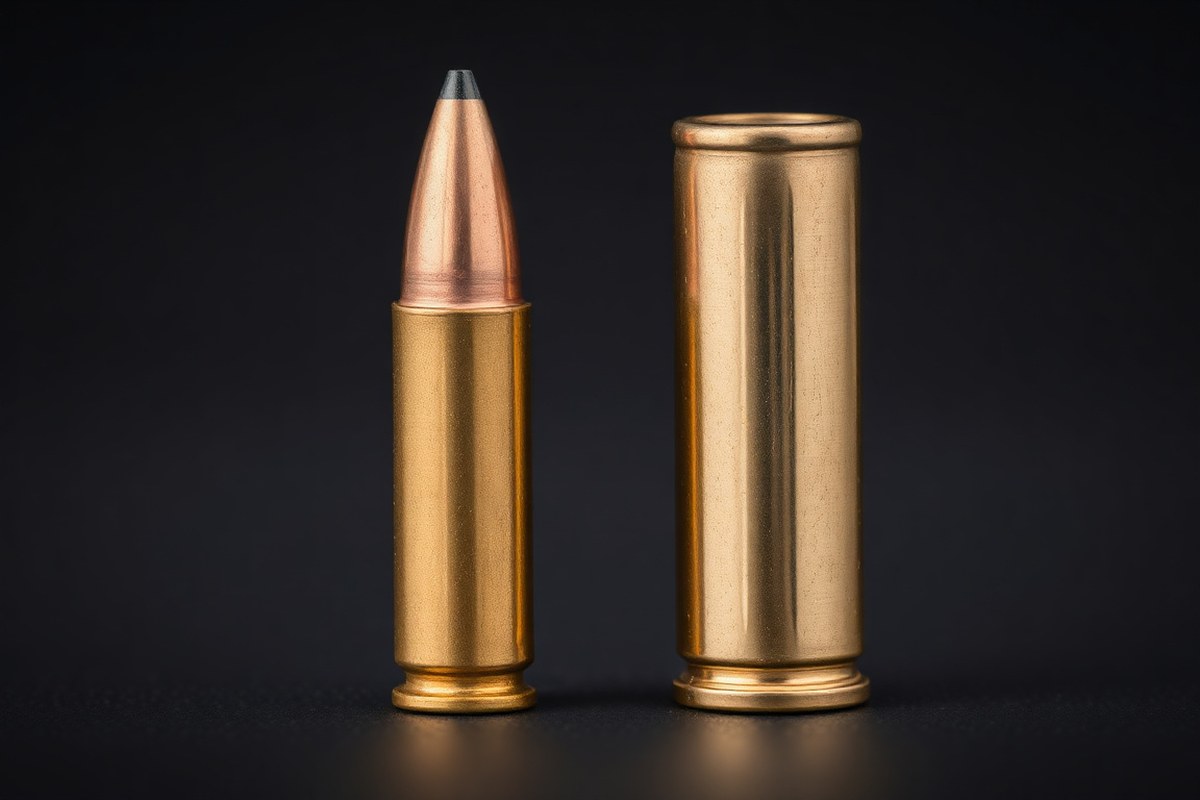
A boat tail bullet features a tapered rear end that narrows gradually, resembling the stern of a boat. This design reduces air drag by smoothing the airflow behind the bullet during flight. Unlike flat-base bullets that create more air turbulence at the base, the tapered shape allows air pressure to flow more cleanly, which improves the bullet’s aerodynamic efficiency.
The key effect of the boat tail shape is a higher ballistic coefficient (BC). Ballistic coefficient measures how well a bullet overcomes air resistance, combining drag and sectional density. A bullet with a higher BC cuts through the air with less deceleration, maintaining velocity longer and resulting in a flatter trajectory and increased energy on impact. For example, a .30 caliber, 169 grain match bullet with a boat tail design typically has a BC around 0.480, giving it better long-range performance than a similar flat-base bullet with a lower BC.
Because the boat tail reduces base drag, it lowers wind deflection and stabilizes the bullet’s flight path. This aerodynamic improvement helps shooters achieve greater accuracy at extended distances, as the bullet is less affected by crosswinds and turbulence. The design is especially valued in supersonic shooting, where air pressure differences become significant. While flat-base bullets may lose velocity faster due to extra drag, boat tail bullets handle the changing air pressure and transonic flight regime (around Mach 1.2) more efficiently.
The boat tail shape also influences the way the bullet seals the barrel. The tapered base means the bullet does not seal the bore as quickly or as fully as a flat-base bullet right after firing. This can have minor effects on initial velocity and pressure. Barrel wear or variations in barrel condition might affect how consistently a boat tail bullet flies over longer ranges, so attention to barrel health helps maintain accuracy. Nevertheless, the tradeoff usually favors the boat tail’s improved stability in the air.
In summary, a boat tail bullet works by reducing rear drag with its tapered base, which improves aerodynamic efficiency, keeps velocity higher for longer distances, and minimizes wind drift. This design makes a significant difference for rifle shooters aiming at targets beyond typical engagement ranges, helping the bullet stay on a truer, flatter flight path and carry more energy upon impact.
How Boat Tail Design Affects Ballistic Performance

The boat tail design significantly improves a bullet’s ballistic coefficient (BC), which measures how efficiently a bullet overcomes air resistance during flight. Higher BC values mean the bullet retains velocity better, flies flatter, and resists wind drift more effectively. For example, a full metal jacket M1943 pattern boat tail bullet has a G7 BC around 0.138, higher than comparable flat-base bullets, which often fall below 0.12 in similar calibers. This improvement results in less velocity loss at extended ranges, maintaining more kinetic energy on target.
Velocity retention is important for longer shots where air drag slows flat-base bullets faster, causing a more pronounced drop and reduced accuracy. Boat tail bullets shed velocity gradually, which produces a flatter trajectory. For instance, compared to a traditional 7.62×51mm NATO flat-base round, boat tail ammo can nearly double hit probability at 1,000 meters by sustaining supersonic speed longer and reducing bullet drop. A flatter trajectory means you spend less time adjusting your aim for bullet drop, making long-range shooting more precise and practical.
Wind resistance is another area where boat tail bullets excel. Their tapered rear reduces turbulent airflow, decreasing wind drift by about one-third or more compared to flat-base bullets of similar mass and velocity. Reduced wind deflection helps maintain point of impact even in gusty conditions, which is particularly valuable for hunting or competition shooting. A typical shooting scenario at 800 meters shows boat tail bullets delivering 40% more retained impact energy versus flat base rounds, improving both accuracy and terminal performance.
The benefits of boat tail design come with tradeoffs. They tend to cost more and cause slightly increased barrel wear due to their aerodynamic shape and often heavier construction. Hollow point boat tail variants offer a balance by maintaining respectable BC while improving expansion on impact but with a somewhat reduced aerodynamic advantage.
To illustrate the impact, consider two bullets of equal weight and caliber: a 150-grain flat-base and a 150-grain boat tail. The flat-base might have a BC around 0.12, dropping faster and drifting more downrange. The boat tail’s higher BC (around 0.16 or more) means less drop and drift, requiring less frequent scope adjustments and delivering greater consistency. This improvement is noticeable beyond 300 yards, especially at 600 yards and up, where velocity and wind deviations become progressively more significant.
Use ballistic calculators alongside field tests at varying distances to verify how much your boat tail ammo improves performance for your specific rifle and conditions.
Boat Tail vs Flat Base: Key Differences and Tradeoffs
Boat tail bullets offer aerodynamic advantages over flat base bullets, especially at longer ranges. Their tapered rear reduces air drag, improving stability and maintaining velocity downrange. This means better accuracy and energy retention when shooting beyond 300 yards. Flat base bullets, on the other hand, stabilize quickly upon leaving the barrel, making them suitable for shorter distances or fast follow-up shots.
Cost-wise, flat base bullets tend to be less expensive due to simpler manufacturing and are widely available. Boat tail bullets usually require tighter tolerances and consistent jackets, which raises their price by approximately 10 to 20 percent compared to flat base options. However, many shooters find the premium worthwhile for long-range hunting, competitive shooting, and precision applications.
Regarding barrel life, both bullet types typically cause similar wear if using factory-loaded ammunition. Some shooters report that boat tail bullets may slightly increase copper fouling due to jacket design but not enough to significantly reduce barrel life.
Choosing between boat tail and flat base bullets depends on your shooting goals. Select boat tail for long-range accuracy, reduced wind drift, and energy retention. Flat base works well for close to medium distances, offer quicker stabilization, and cost less.
| Factor | Boat Tail Bullets | Flat Base Bullets |
|---|---|---|
| Aerodynamics | Superior, reduces drag at long range | Good, stabilizes quickly after barrel exit |
| Applications | Long-range shooting, hunting, precision targets | Short to medium range, training, quick follow-up shots |
| Cost | 10, 20% higher due to manufacturing precision | Lower, widely available and simpler design |
| Barrel Impact | Slightly more potential copper fouling; similar wear | Standard barrel wear; easy cleaning |
| Environmental Sensitivity | More influenced by wind and weather | More stable under varying conditions |
To decide which to use, consider the expected shooting distances and conditions. For shots beyond 300 yards, boat tail rounds generally perform better. Use flat base bullets for close-range target practice or hunting where speed and quick stabilization matter more than ballistic efficiency. Also, factor in your budget since precision boat tail ammo can increase your cost per round.
Types of Boat Tail Bullets and Tip Designs
Boat tail bullets come in several types, varying mainly by construction and tip design. These differences influence how a bullet performs in terms of accuracy, penetration, and terminal effect. Common variants include full metal jacket, hollow point, and soft point bullets, each serving a distinct purpose depending on your shooting goals.
Common Boat Tail Bullet Variants
Boat tail bullets generally split into three broad categories based on their core and jacket materials and design. Traditional lead-core with copper or gilding-metal jackets remain popular for many rifle calibers. Steel-core or armor-piercing designs add penetration for military or tactical use. Some variants replace lead cores with hardened steel penetrators for added durability against tougher targets. Key types include:
- Lead-core with copper or gilding-metal jacket
- Copper-jacketed bullets with exposed steel penetrators
- Full metal jackets covering the entire bullet surface
- Soft point bullets with exposed lead tips
- Hollow point bullets with a cavity at the tip
- Armor-piercing bullets with steel cores or tips
- Match-grade bullets optimized for consistent accuracy
These variants affect weight, ballistic coefficient, and how the bullet interacts with the target on impact.
Full Metal Jacket Boat Tail
Full metal jacket (FMJ) boat tail bullets feature a lead core completely encased in a metal jacket, usually copper or a copper alloy. The boat tail base decreases air resistance, improving long-range stability and velocity retention. FMJs are common in both commercial and military ammunition such as the 173-grain M118 7.62×51mm NATO round used in sniper and machine guns.
FMJ bullets are preferred when reliable feeding, penetration, and target silhouette over distance are priorities. They typically cost less than expanding bullets and have lower barrel fouling. However, they tend to produce less energy transfer on impact compared to hollow or soft points, limiting their stopping power in hunting or self-defense.
Hollow Point and Soft Point Options
Hollow point (HP) and soft point (SP) boat tail bullets are designed to expand upon impact, increasing their stopping power. Hollow points feature a cavity at the tip that causes expansion and energy transfer, although they can create additional air resistance during flight. Soft points have an exposed lead tip that flexes upon hitting a target, promoting controlled expansion and deeper penetration.
Choosing HP or SP boat tail bullets affects both trajectory and terminal ballistics. For example, a 175-grain Sierra Match King hollow point boat tail bullet has a ballistic coefficient of 0.243 (G7 BC), reflecting its balanced aerodynamic shape despite the hollow cavity. These designs are favored in hunting rifles or precision shooting where expanded impact is desired but with the streamlined flight path from the boat tail. Advantages of HP and SP boat tail bullets include:
- Improve energy transfer to the target for better stopping power
- Reduced over-penetration compared to FMJs
- More practical for game hunting and some self-defense scenarios
- Potentially greater air resistance from the hollow cavity, slightly affecting long-range ballistics
- Soft point designs exhibit less drag increase than hollow points, maintaining better trajectory
These bullets may cost more than FMJ ammo and require regular barrel cleaning to prevent fouling from exposed lead.
Match-Grade and Specialized Designs
Match-grade boat tail bullets focus on accuracy and consistency using precise manufacturing processes and high-quality materials. These rounds often combine boat tail designs with optimized ogive shapes and carefully calibrated bullet weights. For instance, the M118 match round uses a 173-grain full metal jacket boat-tail bullet, produced under strict tolerances for competition and designated marksman rifles.
Specialized boat tail bullets include armor-piercing types such as the 7N23 7.62×39mm, which uses a 3.6-gram sharp-pointed steel penetrator for defeating body armor while retaining a soft lead plug to facilitate jacket separation. These designs prioritize penetration over expansion or energy transfer.
Common Applications for Boat Tail Ammo
Boat tail ammo is commonly used when long-range accuracy and stable flight are important. Hunters who pursue bigger game at extended distances benefit from boat tail bullets because their streamlined shape reduces drag and maintains velocity, which improves downrange energy and trajectory. This means you can expect a flatter shot path and more consistent hits beyond 300 yards compared to flat-base bullets. For hunting, select a bullet weight and design matched to your game and rifle type; for example, heavier boat tail bullets in calibers like .308 Winchester excel for deer and elk because they retain energy well at longer ranges.
Competitive shooters favor boat tail ammo for target shooting and match events. The improved aerodynamic efficiency allows for better groupings at distances typically ranging from 600 to 1,000 yards. Precision shooters appreciate how boat tail bullets mitigate wind drift and deliver steadier trajectories under varying conditions. When choosing ammo for competition, look for established match-grade boat tail loads with consistent powder charges and quality manufacturing to ensure repeatable accuracy. Costs for these rounds tend to be higher than standard hunting ammo, reflecting the tighter production tolerances required.
In military and sniper applications, boat tail bullets have a long history and remain prevalent. Rifles such as the M25 sniper rifle and the Mk 14 improve Battle Rifle, an M14 variant, use boat tail bullets to extend effective engagement ranges and improve ballistic performance under field conditions. The 7.62×39 mm cartridge, still common in service rifles like the AK-15, sometimes includes boat tail designs for specialized roles. These bullets provide stable flight over hundreds of yards, essential for designated marksmen and snipers who need first-round hits. Legacy military ammo often serves as a benchmark for commercial long-range boat tail rounds in terms of reliability and external ballistics.
Using boat tail ammo with rifles chambered for typical hunting calibers like .270 Winchester or 6.5 Creedmoor combines the benefits of aerodynamics with terminal performance. You’ll notice better retained velocity and energy past 400 yards, which helps with ethically dispatching game. However, avoid boat tail rounds for short-range handgun shooting since the aerodynamic advantages only become meaningful at distances beyond 200 yards, making them less practical and cost-effective for pistols or revolvers.
Choose boat tail ammunition for your long-range rifle only after confirming your rifle’s barrel twist rate matches the bullet weight to stabilize flight properly and achieve best accuracy.
Limitations and When Not to Use Boat Tail Ammo
Boat tail bullets provide better aerodynamic performance, but they have some practical limitations that make them unsuitable or unnecessary in certain situations. Their design focuses on reducing drag at longer ranges, so for short-range shooting, the benefits are minimal and may not justify the slightly higher cost of boat tail ammo. For example, in hunting or target shooting inside 200 yards, flat base bullets often perform just as well.
Boat tail bullets are rarely used in revolver ammo because revolvers typically operate at lower velocities and shorter ranges. The shorter barrels and lower pressures in revolver cartridges do not gain much from the aerodynamic advantages of a boat tail shape. Most revolver and handgun rounds prioritize reliable feeding, consistent chamber pressure, and adequate performance at typical pistol distances. Also, the manufacturing complexity and cost increase for boat tail bullets are not justified for these calibers.
Not all rifle calibers are suited for boat tail bullets. Some smaller or older cartridges have bullet designs optimized for stability and accuracy with flat bases, or the bullet weights and barrel twist rates do not match well with the longer boat tail profile. Using boat tail bullets in a cartridge not designed for them may cause issues with accuracy or feeding reliability. Always check if the rifle and caliber specification recommend or support boat tail bullets before switching.
- Boat tail bullets increase cost by roughly 10-20% compared to flat base rounds due to more complex manufacturing
- Short-range shooters (under 200 yards) gain little to no velocity or energy advantage from boat tails
- Revolver cartridges typically cannot benefit from boat tail design because of lower velocities and shorter barrels
- Not all rifles have barrel twist rates suitable for stabilizing longer, boat tail bullets, risking reduced accuracy
- Some tactical or semi-automatic rifles prefer flat base bullets for better feeding and reliable cycling
- Using boat tail ammo beyond its designed supersonic range may cause instability when the bullet enters the transonic zone
- Some jurisdictions or shooting ranges restrict the use of match-grade or high-BC ammo for certain events
Choosing when to use boat tail ammo means matching the bullet type to the shooting distance, firearm, and mission. Long-range precision shooters, particularly for rifles firing at or beyond 500 yards, benefit most from boat tail designs. In contrast, hunters focused on woods or brush environments with mostly close to mid-range shots, or shooters using revolvers and most handguns, should usually stick with flat base ammo. Experimenting with a few rounds on a known target range can confirm whether boat tail ammo improves your specific setup before committing to larger purchases.
How to Read Ballistic Tables and Understand BC with Boat Tails
Ballistic tables and coefficients help you predict how boat tail bullets fly through the air, factoring in drag, velocity, and drop. Reading these tables allows you to estimate bullet trajectories and adjust your aim for accuracy over long distances. Understanding the ballistic coefficient (BC) and using trajectory charts guide you in managing bullet drop and wind drift with boat tail ammunition.
Understanding Ballistic Coefficient (BC)
The ballistic coefficient (BC) is a number that measures a bullet’s ability to resist air drag during flight, usually at the midpoint of its trajectory. For boat tail bullets, BC reflects the subtle streamlined base design that reduces drag compared to flat base bullets. You’ll often see BC values expressed using two major drag models: G1 and G7. The G1 model fits flat-based bullets and older standards better, but G7 coefficients are more accurate for modern, boat tail rifle bullets because they better match the actual drag curve. For example, a steel-core boat tail bullet might have a G1 BC around 0.304 and a G7 BC close to 0.152, which affects how you read ballistic tables depending on which model the software or chart uses.
Knowing BC helps you predict how far your bullet will travel before dropping a certain amount and how fast its velocity decreases. Manufacturers or ballistic tools usually report BC measured with Doppler radar or specialized software like PRODAS. A higher BC means less drag and less drop at longer ranges, which makes boat tail bullets popular among hunters and competitive shooters seeking flatter trajectories.
Using Trajectory and Drop Tables
Trajectory tables chart the bullet’s path in terms of height above or below line of sight at varying ranges, usually in yards or meters. Tables include bullet drop data that stems from initial velocity, BC, and environmental factors like air pressure and temperature. To read a ballistic table, first identify the BC used (G1 or G7), muzzle velocity, and sight height. For boat tail ammo, check that the table applies the proper BC for your bullet’s drag model. For example, a boat tail bullet with a G7 BC of 0.200 and a muzzle velocity of 2,700 feet per second might drop 12 inches at 300 yards when zeroed at 100 yards under standard atmospheric conditions (59°F, sea level).
When estimating drop differences with boat tail bullets, compare trajectory data from flat base bullets. Since boat tails reduce drag, you will notice less bullet drop at extended ranges. A quick way to estimate: subtract about 10, 15% from the flat base bullet drop values at 300+ yards to approximate the boat tail drop, if you don’t have a specific table. For more precise results, use ballistic calculators with the correct BC inserted. Always confirm that environmental factors like altitude and temperature are correctly input, since these change the bullet path significantly.
Estimating Wind Drift and Velocity Loss
Wind drift depends on bullet speed, time of flight, and ballistic coefficient. Boat tail bullets, having higher BCs, maintain velocity better and spend less time in the air compared to lower BC flat base bullets, reducing the effect of crosswinds. For example, at 500 yards, a boat tail round with a G7 BC of 0.200 may drift 4 inches less in a 10 mph crosswind versus a flat base bullet with a BC around 0.150.
Velocity loss affects both drop and drift; higher velocity retention means flatter trajectories and less wind susceptibility. Since boat tail bullets shed velocity slower, you get more predictable performance at longer ranges. To estimate, use your ballistic software’s velocity loss output tied to BC and muzzle velocity. Remember that near the transonic range (around Mach 1, or 1,125 fps at sea level), drag spikes sharply and velocity drops faster, which can disrupt boat tail bullet flight consistency. Accurate trajectory prediction should factor this in when shooting at extended distances close to or below this velocity.
Common Mistakes and Tips When Using Boat Tail Ammo
Common mistakes when switching to boat tail ammo include using it in rifles that don’t match the bullet’s design, ignoring barrel wear that affects accuracy, and failing to adjust sights or check ballistic compatibility. Ensuring your rifle and barrel condition support boat tail bullets is key to getting their improved aerodynamic benefits and better long-range performance.
Recognizing Barrel Wear Effects
Barrel wear changes the internal dimensions of your barrel, which can reduce how well boat tail bullets stabilize and group. As barrels wear over thousands of shots, the rifling erosion may cause the bullet to yaw or lose its optimal flight path. This effect can reduce accuracy more noticeably with boat tail rounds than with flat-base bullets due to the boat tail’s longer, tapered shape relying on stable spin and minimal deformation.
Watch for group sizes that grow unexpectedly larger after many rounds fired, or increased velocity variation. This might signal your barrel has worn past the point where it properly stabilizes these bullets. Cleaning the barrel correctly and more often can extend accuracy but replacing or re-barreling could become necessary for serious shooters focused on long-range precision.
Always measure your barrel’s twist rate and inspect for wear before switching to boat tail ammo if you notice a sudden drop in accuracy.
Matching Ammo to Rifle Type
Not every rifle benefits equally from boat tail bullets. Their aerodynamic design favors rifles with higher muzzle velocity and appropriate twist rates to stabilize these longer projectiles. For example, a 1:8 inch twist rate is typically suitable for 168 or 175 grain boat tail bullets in .308 Winchester, but a slower twist might cause keyholing or poor grouping.
Consider the rifle’s typical engagement distance and whether it feeds well with the boat tail bullet’s shape. Some bolt-action rifles excel with boat tail ammo, while semi-automatics may have feeding reliability issues unless the ammunition is chosen carefully. Checking manufacturer specs or consulting ballistics data tables aligned with your rifle can help verify compatibility.
- Verify barrel twist rate matches bullet weight and length
- Assess feeding smoothness in semi-automatic rifles
- Match ammo ballistics to typical range distances
- Check recoil and muzzle blast changes that affect follow-up shots
- Test for consistent velocity and grouping at your intended range
Using a chronograph and target shooting at 100 and 200 yards helps confirm whether boat tail ammo fits your rifle’s performance goals.
Optimizing for Long-Range Accuracy
Boat tail bullets excel at maintaining supersonic velocity longer thanks to reduced drag, which translates into flatter trajectories and better energy retention at long distances. To optimize results, adjust your sights specifically for the ballistic profile of the boat tail round you use. For example, many boat tail factory loads assume iron sights 1.5 inches above the bore, with point of aim matching point of impact at 200 yards.
Scout your actual impact points at 100, 200, and 300 yards to verify sight adjustments. Ignore this step, and you may misjudge holdovers or wind calls. Also, environmental factors like air density and temperature affect bullet flight despite boat tail design advantages. Consider using a ballistic calculator and adjusting for local conditions to fine-tune your shooting.
Neglecting proper sight zeroing specific to your boat tail ammo can cause missed shots even with high-BC bullets.
Getting Started with Boat Tail Ammo: A Simple Action Plan
Begin improving your shooting accuracy and consistency by using boat tail ammo the right way. Follow these practical steps to see noticeable results quickly.
- Before your next range session: Choose a boat tail bullet that matches your shooting needs, target, hunting, or competition, to ensure proper performance.
- First range outing: Fire a small group of five shots at a known distance and check your grouping size and point of impact to establish a baseline.
- After initial shooting: Adjust your scope or sights based on the observed groupings to optimize for the boat tail bullet’s flight characteristics.
- Within your first week of practice: Record muzzle velocity and group size to compare with ballistic tables, confirming expected performance improvements.
- Ongoing practice: Monitor environmental factors like wind and temperature as boat tail rounds can be more sensitive; note changes to improve your shot adjustments.
- After a few sessions: Test different bullet tip designs with the same boat tail base to find what suits your rifle and shooting style best.
- Two to three weeks in: Evaluate consistency and accuracy improvements. If boat tail ammo isn’t delivering better results than your previous rounds, reconsider your bullet selection or rifle setup.
Frequently Asked Questions
What Is the Main Benefit of Boat Tail Ammo for Long-Range Shooting?
Boat tail ammo reduces air resistance, resulting in higher velocity and a flatter trajectory, which helps maintain accuracy over longer distances. This means you get better performance for extended-range shots compared to flat base bullets.
Does Boat Tail Ammo Affect Barrel Wear Differently Than Flat Base Bullets?
Boat tail ammo may not seal the bore as quickly, so barrels showing wear can alter bullet flight more noticeably at longer ranges. Keep an eye on barrel condition for consistent performance with boat tail bullets.
Can Boat Tail Bullets Improve Impact Energy Compared to Other Designs?
Yes, boat tail bullets typically deliver more energy on impact due to their higher ballistic coefficient, which maintains velocity better. This makes them effective for hunting and competitions where terminal performance matters.
Are Full Metal Jacket (FMJ) Boat Tail Bullets Suitable for Training Purposes?
FMJ boat tail bullets are generally good for range training because of consistent flight and lower cost, while still offering the aerodynamic benefits of a boat tail design. They balance accuracy and affordability for practice.
How Does Barrel Wear Influence the Accuracy of Boat Tail Ammo over Time?
Barrel wear can cause boat tail bullets to fly less predictably since they rely on tight bore sealing for consistent flight. Regular maintenance and monitoring are key to maintaining long-range accuracy with them.
Is a Boat Tail Bullet Always the Best Choice for Every Type of Shooting?
Boat tail bullets excel at long-range and flat trajectories, but their slower bore sealing means they may underperform in shorter-range or worn-barrel scenarios. Choose ammo based on your shooting conditions and barrel health.
Wrapping Up
Boat tail ammo offers tangible benefits in terms of aerodynamic efficiency and long-range accuracy when matched properly to your shooting scenario. Use it thoughtfully with careful load selection and environmental awareness to maximize results. Your next step is to select a quality boat tail bullet that fits your shooting style and test it under controlled conditions to see how it performs from your rifle.