How to Hide a Large Gun Safe Securely: 8 Practical Concealment Methods
How to hide a large gun safe starts with choosing a location that offers both concealment and easy access. The best approach is to place the safe in a low-visibility, climate-controlled area like a closet, under stairs, or behind large furniture. Start by measuring your safe and confirming the spot’s dimensions to ensure a perfect fit that won’t attract attention or compromise your firearms’ condition.
Key Takeaways
- Place large safes in temperature-stable, low-humidity areas to protect guns from moisture damage.
- Choose locations with low visibility but convenient access, such as closets or behind furniture.
- Avoid attics or high floors that may not support the safe’s heavy weight, which can exceed 1,000 pounds.
- Use concealment furniture like bookcases or tactical shelves designed to disguise gun safes effectively.
- Measure your safe and potential hiding spots carefully to prevent noticeable gaps or awkward positioning.
- Balance concealment with quick access by selecting spots that don’t require moving heavy items to open the safe.
1. Best Methods to Hide a Large Gun Safe Effectively

Hiding a large gun safe effectively involves choosing a method that secures your firearms while keeping them accessible when needed. The best approaches balance these priorities without breaking your budget or requiring complicated installation. Four common methods for concealing large gun safes are wall safes, furniture disguises, floor compartments, and closet concealment. Each offers its own mix of benefits, installation demands, and risks.
A wall safe is built into the structure of a home, often behind a removable panel or framed by drywall. This method is excellent for saving floor space and keeping the safe out of obvious sight. Security is high since it’s embedded into the wall, but installation usually needs a professional. A DIY attempt risks weakening the structure or leaving visible seams, defeating the concealment. Costs vary but expect several hundred dollars for materials plus labor.
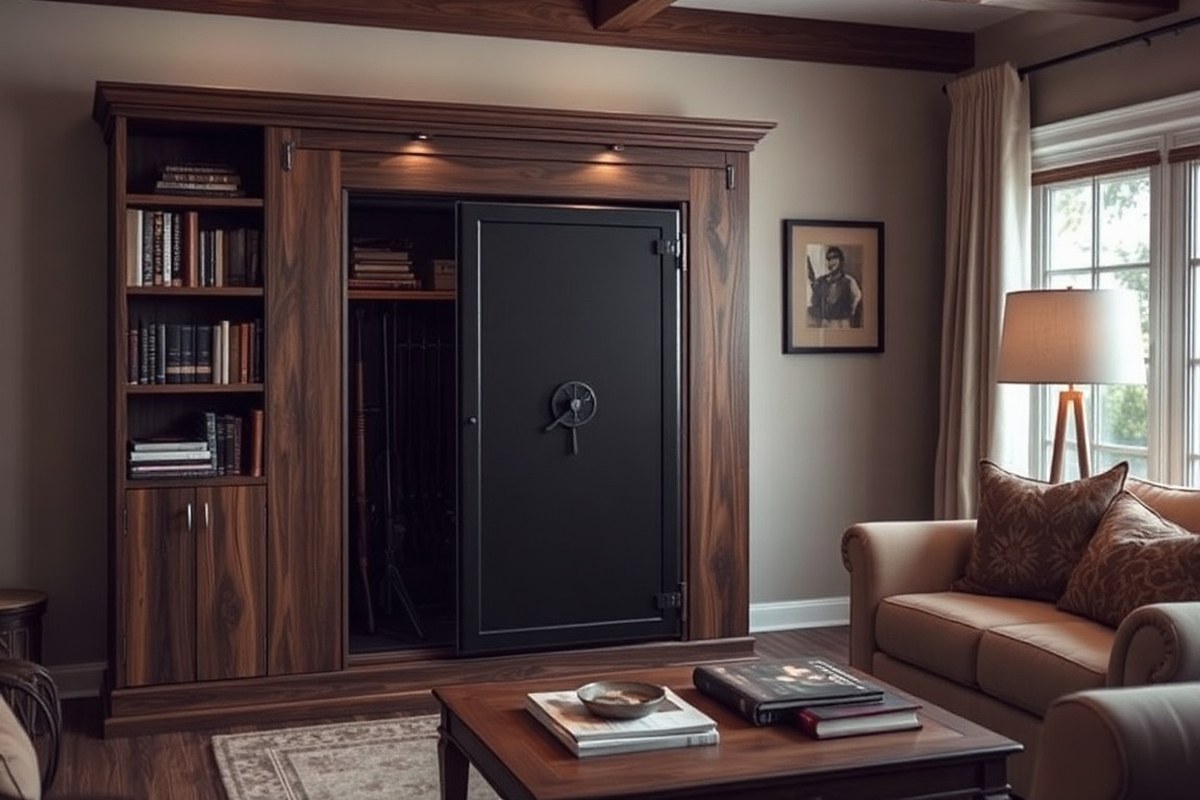
Furniture disguises use large pieces like bookshelves, cabinets, or custom-made units to hide a gun safe. These can be purchased or built at home. Furniture disguises offer moderate security; the safe is somewhat visible but masked as ordinary furnishing. Accessibility is good because the safe can be reached quickly. Installation is generally straightforward and affordable, especially if using existing furniture. The downside is that familiar visitors may become curious about unusually heavy or bulky pieces.
Floor compartments conceal the safe beneath removable floor panels or trap doors. This method keeps your firearms out of the line of sight and offers solid protection against theft since the safe is hidden below ground level. Installation typically requires cutting and reinforcing subfloor areas, which can be costly and labor-intensive. Access takes a few extra seconds but remains reasonably fast. Floor compartments should be installed in low-traffic areas to avoid accidental discovery.
Closet concealment involves placing the gun safe behind clothing or boxes inside a closet. This method is one of the easiest and most cost-effective to set up. The tradeoff occurs with accessibility and security since closets are common targets for burglars. For improved safety, bolt the safe to the floor or wall and use heavy-duty locks. This method suits those prioritizing quick access over stealth concealment.
Below is a comparison table summarizing these methods to help weigh the pros and cons. Selecting a method depends on your home’s layout, security needs, and how quickly you might need to access your firearms.
| Method | Installation Effort | Security Level | Accessibility | Cost Range | Ideal Use Case |
|---|---|---|---|---|---|
| Wall Safe | High (professional recommended) | High (embedded in structure) | Moderate (needs panel removal) | $300 – $1,000+ | Space-saving, high-security needs |
| Furniture Disguise | Low to Moderate (DIY feasible) | Moderate (visible but masked) | High (easy to access) | $100 – $500+ | Blending with decor, affordable |
| Floor Compartment | High (modification of flooring) | High (hidden below floor) | Moderate (requires panel lifting) | $400 – $1,200+ | Hidden in low-traffic rooms |
| Closet Concealment | Low (basic setup) | Low to Moderate (common area) | High (quick reach) | Minimal, under $100 | Quick access, budget-conscious |
You can increase the effectiveness of any method by bolting the safe down to prevent removal and using lock systems that resist tampering. Some manufacturers provide concealment safes disguised as shelves or other household objects, combining aesthetics with security. Consider your daily routine, the size and weight of your safe, and who may have access to your home when choosing a hiding method.
2. Ideal Home Locations for Hiding Large Gun Safes

Choosing the right location to hide a large gun safe depends on balancing security, environmental conditions, and easy access. Ideal spots include basements, closets, home offices, and less trafficked areas, where you can control temperature and humidity while limiting visibility to outsiders. Considering the structural support, climate control, and privacy of each space helps prevent damage and theft risks.
Basements: Climate and Load Considerations
Basements often provide a cooler, stable temperature environment that suits gun safes, minimizing rust and moisture damage. They usually have lower humidity levels if properly ventilated, but you must assess for dampness or flooding risks. Basements generally support heavy weights, making them appropriate for safes exceeding 1,000 pounds.
Keep in mind that poorly maintained basements can suffer from mold or water intrusion, which may harm your firearms inside the safe. Installing a dehumidifier can keep humidity within 30% to 50%, aligning with manufacturer recommendations for gun storage.
Closets and Low-Traffic Rooms for Discretion
Closets and seldom-used rooms like home offices offer valuable privacy and limit visibility to guests. They also allow customization options, such as hidden panels or furniture disguises, to stealthily conceal the safe. These spaces benefit from easy monitoring of temperature and humidity but often need additional climate control devices.
Closets in interior rooms of your home will generally have more stable temperatures and lower moisture than exterior-facing rooms. Avoid closets directly above garages or attics as these lack insulation and can fluctuate in climate.
Living Rooms and Bedrooms: Access vs. Security Tradeoffs
Rooms where you spend significant time, like living rooms or bedrooms, offer convenience for frequent access. However, safes placed here are more visible and exposed to guests or passersby unless effectively disguised. Large windows in these rooms increase burglary risk if the safe is visible from outside.
To reduce risks, place the safe in corners or behind custom furniture, and avoid locations with direct sight lines from doors or windows. These options increase accessibility but require more sophisticated concealment methods.
Garage and Kitchen Spaces: Practical but Risky Options
Garages have limited space and often do not offer the required climate control for gun safes, making them less ideal. Exposure to temperature swings and humidity can lead to firearm deterioration. Kitchens might contain small, hidden spaces but are susceptible to moisture and heat fluctuations.
Using a garage or pantry for a large safe demands moisture barriers, climate control upgrades, and careful concealment to prevent easy detection. These locations should only be selected if better options are unavailable.
Checklist for Selecting the Best Location
Use this decision rule checklist to evaluate each potential spot for your large gun safe:
- Structural Support: Confirm the floor can support the safe’s weight (often >1,000 lbs).
- Climate Control: Choose locations with stable temperatures (60°F, 75°F) and humidity below 50%.
- Visibility: Opt for low-traffic, concealed areas away from exterior windows or obvious paths.
- Accessibility: Ensure easy yet secure access without drawing attention.
- Security: Select areas with possible additional locks, alarms, or barriers.
- Space Availability: Measure clearance for installation and future access.
- Customization Potential: Assess if modifications like hidden panels or disguised furniture are feasible.
Scoring each potential location against these criteria helps prioritize your choice effectively. Keep in mind that modifications for better concealment or climate control may add $200 to $1,000 depending on complexity.
Always inspect the location for unexpected moisture or structural issues before installing a heavy gun safe to avoid costly damage later.
3. Creative Gun Safe Disguise Options to Blend In
Hiding a large gun safe effectively requires blending it into your home’s existing decor so it doesn’t stand out. Creative disguises like camouflaged furniture, hidden wall panels, and decorative covers can turn your gun safe into an unnoticeable part of the room. These methods not only keep your firearms secure but also maintain quick access when needed.
Furniture with Hidden Compartments
Furniture disguised to conceal a gun safe is an excellent option when floor space allows. Pieces such as bookcases, armoires, or large cabinets can be custom-built or adapted to house the safe within them. This approach works well because the safe looks like a normal furniture piece and doesn’t draw suspicion.
Custom furniture designed to fit over or around your gun safe often includes features like removable panels or false backs. For example, a large bookshelf might have a hidden compartment behind books or decorative objects, with a panel securing the safe’s door. Costs for custom furniture can range from $500 to $2,000, depending on size and materials.
Homeowners sometimes convert existing items by reinforcing the interior to support the safe’s weight and size. Reinforcement ensures the furniture remains sturdy under the safe’s heavy weight, which can exceed 1,000 pounds for larger models. Also, concealment furniture can be themed to match the room, like rustic wooden chests for a den or sleek modern cabinets for a living room.
Artwork and Wall Hangings Concealment
Artwork and wall hangings create discreet layers over the gun safe, making it virtually invisible. Large paintings, mirrors, or framed photographs mounted on sliding panels or hinged frames offer quick access to the safe behind them. This works particularly well for wall-mounted gun safes or those recessed into a wall niche.
To implement this, attach your artwork to a frame that functions as a door, mounted with sturdy hinges and secured with a magnetic or mechanical lock. The artwork itself should blend with your home’s style, choose pieces that reflect your personal taste while covering the safe completely. Costs vary widely, with DIY options possible for under $100, while custom sliding frames and art pieces can exceed $500.
Sliding wall panels also conceal safes while preserving easy reach. For a practical setup, mount the panel on tracks and disguise those tracks with crown molding. This method keeps your safe flush with the wall and camouflaged by a decorative facade, ensuring it doesn’t catch the eye.
Decorative Items and Seasonal Coverings
Decorative items can provide a budget-friendly way to camouflage your gun safe, especially if large furniture or wall modifications aren’t feasible. Placing tall plants, large vases, or seasonal decorations like holiday posters or wreaths in front of the safe helps obstruct direct sight lines without permanent construction.
This option works best when the safe is in a corner or near existing decor that naturally groups in one area. You can rotate seasonal items to refresh the disguise throughout the year, keeping your concealment strategy adaptive. These items should be heavy or secure enough to not be moved easily, preventing accidental discovery.
Decorative covers, such as slipcovers or tailored fabric drapes designed for gun safes, offer additional protection from dust and scratches while disguising the safe. Slipcovers often cost between $30 and $100 and come in colours and patterns matched to typical home styles.
- Tall potted plants to obscure lower-level safes
- Seasonal or holiday decorations rearranged regularly
- Decorative screens or room dividers placed strategically
- Large rugs to cover floor safes while complementing the room
- Fabric slipcovers tailored to match furniture patterns
These elements can help mask the safe while still allowing easy access as you only need to move or adjust the covering item.
Safe Cloaks and Custom Covers
Safe cloaks are soft covers crafted specifically to conceal and protect gun safes. These covers help them blend in visually by matching colours or mimicking textures found elsewhere in the home. Safe cloaks protect your investment from dust and minor scratches, prolonging the safe’s finish.
Custom-made covers can fit precisely over your safe’s dimensions, ensuring no gaps reveal its shape. Materials typically include padded fabric or durable nylon, and prices generally range from $50 to $150. Many users prefer safe cloaks for safes kept in garages or basements where aesthetics matter less but protection remains important.
In addition to ready-made covers, some companies offer custom-built enclosures that disguise gun safes inside another piece of furniture or structure, such as a refrigerator shell or large cabinet. These options demand a higher budget ($1,000 to $3,000) but provide excellent concealment.
4. Balancing Accessibility and Security for Concealed Gun Safes
Maintaining both quick access and high security for a hidden large gun safe requires choosing the right locking system and smart placement. The goal is to ensure authorized users can retrieve firearms swiftly during emergencies while keeping the safe concealed from intruders. One effective approach is using biometric locks, which rely on fingerprint recognition. These locks typically open within seconds, providing immediate access without fumbling for keys or codes. They also reduce the risk of unauthorized entry because fingerprints are difficult to duplicate. Biometric lock systems for gun safes generally cost between $150 and $400, depending on quality and integration.
RFID technology is another viable option for quick access combined with good concealment. RFID tags or cards get the safe instantly when swiped near the reader, allowing discreet and fast opening. This method avoids noisy keypad use or searching for keys during critical moments. However, RFID systems need careful management of the tags or cards, as losing them poses a security risk. Costs for RFID-enabled gun safes start around $200 and increase depending on features.
Combination locks also provide a balance of speed and security. They allow quick entry with a code known only by authorized users and do not require carrying keys. Mechanical dials or digital keypads can both work, with digital keypads enabling faster code entry. A strong, well-chosen code should be at least six digits or characters for security. Combination locks are widely available on gun safes, often adding $50 to $150 to the safe’s price. Keep in mind that keypad use may draw attention through noise or visible use locations.
Placement plays a critical role in accessibility and security. A master bedroom location offers immediate access; placing the gun safe inside a walk-in closet, an alcove, or behind a false panel provides concealment while ensuring there is enough room to open the safe door fully. Avoid locations that are obvious targets, like near windows or easily discoverable furniture pieces. It’s essential to keep the existence and access method of the concealed safe strictly confidential, limiting knowledge to trusted individuals only.
When considering locking types and access methods, think about the tradeoffs in your household. Biometric locks offer speed but can be affected by dirt or skin damage. RFID tags are convenient but easily lost. Combination codes require memorization and can be observed if used openly. In families with children, higher placement and advanced locking mechanisms prevent accidental or unauthorized access. In all cases, investing in a quality safe built with solid US steel and reliable fire protection adds another layer of security.
To complement locking and placement strategies, consider gun safe covers to blend the safe smooth with its surroundings and protect it from dust. Combining these methods creates a secure, hidden gun safe that you can access quickly in emergencies without compromising concealment or safety.
5. Environmental Factors Affecting Gun Safe Placement and Concealment
Temperature and humidity control are critical for gun safe placement because firearms and ammunition can suffer damage over time if stored in unhealthy environments. High humidity promotes rust and corrosion on metal parts, which compromises your weapons’ reliability and safety. Ideal relative humidity inside the safe should be maintained between 30% and 50% to prevent moisture buildup. You can achieve this by using dehumidifiers or moisture-absorbing products like silica gel packs inside the safe.
Placing a gun safe in a climate-controlled area of your home is best, avoiding spaces like uninsulated garages or damp basements that experience temperature swings or high moisture levels. Keep the safe away from direct sunlight or heat sources, which cause temperature fluctuations that worsen condensation inside the safe.
The floor where you place your gun safe must be strong enough to support its significant weight safely. Large gun safes often weigh between 500 to 1,500 pounds or more. Placing such a safe on an upper floor requires confirming that the flooring and joists can bear that load without risk of damage or collapse. Consult a structural engineer or a licensed contractor if you have any doubts. Reinforcing the floor or moving the safe to a ground-level concrete slab floor can prevent structural problems. Consider these environmental factors as a checklist when choosing where to conceal your gun safe:
- Select a location with stable indoor temperature, ideally between 65°F and 75°F.
- Keep relative humidity in the area and inside the safe between 30% and 50% using dehumidifiers or dessicants.
- Verify the floor load capacity, especially for upper floors, with professional assessment if needed.
- Choose dry, well-ventilated spaces away from water leaks or flooding risks.
- Avoid placing the safe in direct sunlight or near heating vents to minimize temperature swings.
- Use floor protectors or a reinforced base to evenly distribute the safe’s weight and protect flooring.
Concealing a large gun safe in areas like a basement or garage only works if these environmental considerations are met. Neglecting humidity control can lead to rusted firearms that lose their value and functionality. Ignoring floor support risks structural damage to your home and unsafe safe placement. Cost for environmental preparations varies: silica gel packs cost around $10 to $30 per pack, small dehumidifiers may range from $50 to $150, and professional floor reinforcement could run hundreds to thousands of dollars depending on complexity.
Always test your floor’s strength before placing a heavy safe upstairs to avoid costly damage and safety hazards.
6. Mistakes to Avoid When Hiding a Large Gun Safe
One common mistake when hiding a large gun safe is poor stability. If the safe is not securely anchored, it can tip or slide, risking injury or damage to the safe and its contents. To fix this, bolt the safe to the floor or wall using heavy-duty anchors rated for the safe’s weight, which often exceeds 500 pounds. This prevents accidents and keeps the safe in place if moved or bumped.
Another frequent error is making the safe too obvious. Concealment should avoid showing unusual shapes, sizes, or features that draw attention. Using plain, solid-colored covers can backfire because they stand out in contrast to typical surroundings. Instead, disguise the safe with materials and colors that blend naturally with the room’s décor, such as behind false walls, inside furniture, or hidden by books or cabinets. This keeps the safe from easy discovery by burglars or visitors.
Access is often overlooked in concealment. Placing a safe in a hard-to-reach spot might deter thieves but also delays your access in emergencies. The fix is to balance concealment with convenience by choosing locations that allow quick opening while remaining hidden. Installing a reliable lock and using keypad or biometric access can improve security without compromising speed.
- Secure the safe with bolts or anchors rated for at least the safe’s weight
- Avoid plain covers that reveal unusual outlines or shapes
- Integrate the safe’s appearance with surrounding furniture or walls
- Choose hiding spots that allow easy yet discreet access
- Regularly inspect concealment materials for wear or damage
- Keep keys or combinations separate from the safe location
Another key mistake is neglecting child safety. Concealing a gun safe must also involve restricting unauthorized access effectively. This means combining physical concealment with secure locking systems and ensuring children cannot find the safe or its key. Failing to do so increases the risk of accidental harm.
Environmental oversight can also undermine concealment. Avoid spots exposed to temperature extremes or moisture that might damage the safe or its locks. A dry, stable climate-controlled room reduces the risk of rust or lock malfunction, preserving both security and the condition of your firearms.
7. Professional vs DIY Concealment: When to Hire Experts
Large gun safes can be hard to conceal effectively without risking damage to your walls or the safe itself. Hiring a professional is the best choice when the concealment requires structural changes, like building custom cabinetry, false walls, or bookshelf covers. Professionals have the tools and skills to make the modifications clean and secure. They can also ensure the safe remains fully accessible and stable, which you might miss attempting it yourself. Expect to pay between $300 and $1,200, depending on complexity and materials.
DIY concealment methods work well for simpler options like using fabric covers, zipper-paneled gun safe covers, or positioning the safe behind existing furniture. These cost much less, generally under $100 for materials, and protect the safe from dust and scratches as well. The risks include less precise fitting, potential gaps or weak spots where the safe is visible, and the chance of damaging the safe or wall without professional experience. Choose DIY only if you are comfortable with basic tools and have time to measure carefully.
| Aspect | Professional Concealment | DIY Concealment |
|---|---|---|
| Skill Required | High; carpentry and design experience | Basic; measuring and using simple tools |
| Typical Cost Range | $300 to $1,200 | Under $100 |
| Time Investment | Few hours to a day | Several hours to multiple days |
| Durability and Finish | Professional-grade fit and appearance | Varies; often less polished |
| Accessibility | Optimized for quick safe access | May obstruct or reduce easy access |
| Risk of Damage | Low; pros avoid unnecessary damage | Higher; tools misuse or poor planning |
| Concealment Options | Custom built-in concealment, false walls | Fabric covers, furniture rearrangement |
Choosing professional concealment is wise for any complex or permanent solution. This includes built-in cabinetry that completely hides the safe or disguised doors that double as décor. Professionals can match the home’s style, increasing the concealment’s effectiveness without obvious indicators. You should consider DIY only when you want a temporary or less costly cover like a gun safe zipper panel that looks like a piece of furniture or simply reduces the safe’s visibility indoors. Keep in mind the DIY route requires patience and willingness to correct errors during the process.
8. Improving Concealment with Technology and Secure Access Tools
Modern lock and alarm technologies improve the concealment and security of large gun safes by providing quick, reliable access for you while keeping unauthorized users out. Using biometric, RFID, or electronic locks combined with integrated alarms and surveillance can significantly reduce risks linked to break-ins or accidental access. These systems also allow you to keep your safe hidden behind furniture or disguised doors without sacrificing convenience.
Biometric and RFID Access Systems
Biometric locks use fingerprint recognition, allowing you to unlock your safe in less than a second simply by scanning your finger. These locks improve concealment by eliminating the need for visible keys or codes that can be stolen or forgotten. Biometric systems work well for large gun safes hidden in accessible spots like custom cabinets or closet frames, where rapid access is critical.
RFID locks operate by scanning a wristband, card, or fob near the safe to unlock it. These can also be discreetly embedded into furniture or safe designs. RFID keys offer quick entry and are easy to carry on your person, reducing the risk of losing traditional keys. Combining biometric and RFID systems increases security by requiring two forms of authentication.
Mechanical and Digital Combination Locks
Mechanical dial combination locks are highly reliable since they don’t depend on batteries or electronics. Their classic appearance can blend well with traditional safe designs while maintaining strong security. Digital combination locks allow quick code entry on a keypad, often programmed with multiple user codes and time delay features to thwart unauthorized attempts.
Choosing between mechanical and digital locks depends on your priorities: mechanical ones never fail from power loss but take longer to open, while digital locks provide faster access with the risk of dead batteries. Some models combine digital keypads with backup mechanical overrides. Prices for digital locks generally range from $100 to $300, while mechanical ones can be less costly but require practice to use confidently.
Integrated Surveillance and Alarm Options
Adding surveillance cameras that monitor your safe’s location, along with door and vibration alarms, increases security and deterrence. These systems connect to your smartphone or home security network, sending instant alerts if tampering is detected. Cameras can be hidden in nearby fixtures like smoke detectors or picture frames to avoid alerting intruders to the exact safe location.
Common alarm features include motion sensing around the safe door, audible alarms sounding at over 100 decibels, and silent alerts to your phone or security company. Integrating alarms with electronic lock systems ensures that any unauthorized access triggers immediate responses, while authorized users maintain silent, rapid entrance.
- Fingerprint scanners for quick biometric access
- RFID wristbands or key fobs for contactless unlocking
- Mechanical dial locks for battery-free security
- Digital keypad locks with multiple user codes
- Hidden surveillance cameras with remote monitoring
- Vibration-activated alarms and door sensors
- Smartphone alerts integrated with home security systems
Always test your electronic lock’s battery life regularly and have a mechanical backup method to avoid lockouts during power failures.
Step-by-Step Action Plan to Hide Your Large Gun Safe
Follow this plan to secure and conceal your large gun safe effectively while keeping quick access in mind.
- Before you start: Measure your gun safe and potential hiding spots accurately to ensure a proper fit and confirm ease of access.
- Day 1: Choose a low-traffic, environmentally stable location like a closet behind drywall or a basement alcove; test for dryness and stable temperature.
- Day 2: Select your disguise method, built-in cabinetry or faux wall panels, and gather materials to blend the safe smooth into your space.
- Day 3: Install your concealment structure or false facade securely; verify that it can be accessed without disturbing other household items.
- Day 4: Add security technology such as biometric locks or alarm sensors; perform tests to confirm they respond correctly to authorized access.
- Day 5: Review your concealment from different angles and lighting to ensure the safe remains unnoticed; adjust lighting or décor if needed.
- After 1 week: Practice accessing your safe covertly and quickly under various conditions to balance security with readiness.
Frequently Asked Questions
Can I Hide a Large Gun Safe in a Basement Effectively?
Yes, basements offer good concealment with less foot traffic and fewer windows. Use drywall or cabinetry to blend the safe into the surroundings, which also protects against environmental damage like moisture if properly managed.
Is It Legal to Hide a Gun Safe Inside My Home?
Generally yes, but laws vary by state regarding firearms storage. Always follow local regulations and ensure your safe meets security requirements to avoid legal issues.
How Much Space Do I Need to Hide a Large Gun Safe?
Space depends on the safe’s dimensions plus room for access, typically about 3 to 6 feet wide and deep. Ensure enough clearance for the door to open fully without obstruction.
Does Hiding a Gun Safe Reduce Its Effectiveness for Quick Access?
It can delay access slightly, but balancing concealment with placement in frequently used areas helps. Concealment methods like disguised furniture can keep it out of sight while remaining accessible.
Can I Hide a Gun Safe in a Garage Safely?
Yes, garages are good for large safes if environmental factors like temperature and humidity are controlled. Conceal it inside a cabinet or behind storage units to maintain security and accessibility.
Will Placing a Gun Safe Behind Large Furniture Increase Fire Protection?
Furniture may provide minor protection, but it won’t replace fire-resistant safes or dedicated fireproof rooms. Prioritize safes specifically rated for fire protection when this risk is a concern.
Wrapping Up
Securing your large gun safe with effective concealment methods safeguards your firearms while maintaining ready access. Start by selecting the right spot and disguise that fits your home’s layout and your lifestyle. Your next step should be to assess your chosen area’s environment to avoid moisture or temperature risks that can damage your firearms or safe.